About Nymania capensis (Thunb.) Lindb.
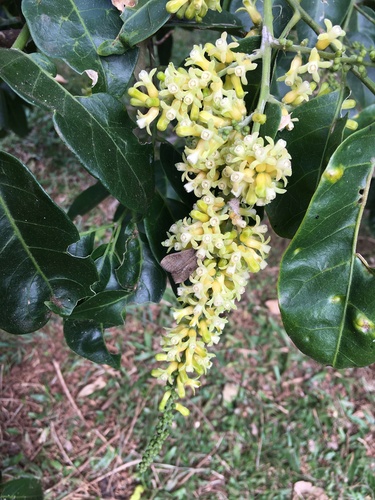
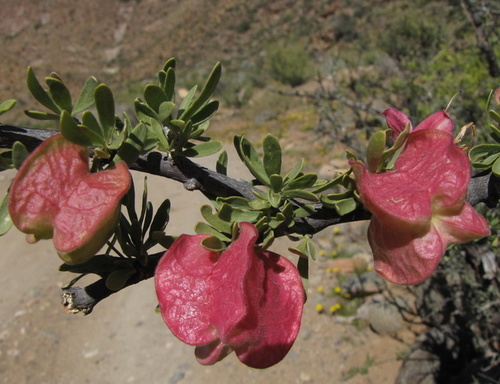
Nymania capensis is a plant species commonly called "Chinese lantern" in English, named for the shape of its bright, colourful fruit. In Afrikaans it is called "klapper", which translates to "firecracker", because children sometimes pop its dry capsules for fun. It is the only species in the genus Nymania. This plant grows as a thin, scrubby, woody shrub or small tree, and typically reaches 0.5 to 3 meters in height. It is endemic to South Africa and adjacent bordering territories, where it occurs most often in inland regions of the country's central, northern, and eastern areas. It grows primarily in Karooid regions, in scrub within gorges, but can also be found on open veld and river banks in the Great Karoo, Little Karoo, Namaqualand, and Kalahari. Its leaves are alternate and fascicled, simple, and roughly linear in shape. Flowers are solitary, borne on pedicels in leaf axils. Both the corolla and calyx each have four lobes, with eight stamens inserted at the base of the floral disc, and the stamen filaments are joined at their base. The ovary is superior and sessile, with four lobes and four locules; each locule holds two collateral ascending ovules. The stigma is simple, and the style extends further out than the stamens. The fruit is an inflated membranous capsule 3 to 5 cm across, with each locule forming a distinct lobe. Ripe seeds are hard and rounded, about 2 to 4 mm in diameter. Due to seed abortion, a locule may contain fewer than two seeds. The capsules are too heavy to be carried by wind, but when ripe they are sometimes blown across the veld, carrying their seeds like miniature tumbleweeds. Carl Peter Thunberg originally described this species as Aitonia capensis, in honour of William Aiton, and Sextus Otto Lindberg later reclassified it into the genus Nymania, named to honour Carl Fredrik Nyman. Nymania capensis remains the only accepted species in the genus Nymania Lindb. A different taxon, Nymania insignis K.Schum., belongs to a junior homonym genus Nymania K.Schum. in the family Euphorbiaceae, and is now a synonym of Phyllanthus clamboides. The genus Nymania has been assigned to the families Sapindaceae, Aitoniaceae, and Meliaceae at different times, and its correct family placement is still under review. Certain characteristics, such as its pollen type, still lead to uncertainty for taxonomists studying the group. While the species is currently valued as an ornamental plant, it is not easy for amateur gardeners to germinate from seed, and it has not had much other material practical importance. It has been recorded being used in folk medicine to treat convulsions. Goats will browse the plant, but it is rarely abundant enough to be an important major source of forage.