About Nyctemera annulatum Boisduval, 1832
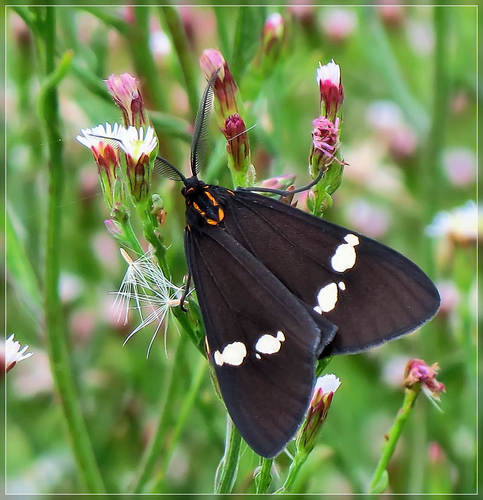
Fully grown "woolly bear" caterpillars of the magpie moth Nyctemera annulatum Boisduval, 1832 measure 35–38 mm long. They are mostly black, with red lines running along their sides and back, blue spots, and hair tufts on every body segment. Because these caterpillars feed on introduced ragwort, they are sometimes misidentified as caterpillars of the cinnabar moth, a species introduced to control ragwort biologically. Unlike magpie moth caterpillars, cinnabar caterpillars have smooth bodies marked with alternating yellow and black rings. Adult moths have black wings with white markings on both forewings and hindwings: forewings have two elongated white spots, while hindwings have only one white spot near their center. The adult wingspan ranges from 35–45 mm. The moth’s thorax and abdomen are black with orange bands. Nyctemera annulatum is diurnal, and its bright coloration often leads people to mistake it for a butterfly. It is most active from September to June, during mornings and evenings, when it can be seen flying above the tops of its host plants. This species is closely related to Nyctemera amica, an Australian species that also occurs in New Zealand, and the two species may be able to interbreed. Globally, Nyctemera annulatum is found only in New Zealand, where it occurs across the entire country: on the North Island, South Island, and smaller outlying islands. N. annulatum caterpillars can survive freezing by entering a frozen state, and this cold and freezing temperature tolerance allows the species to live throughout all of New Zealand. Nyctemera annulatum only occurs in habitats where Senecio species grow. It is most common in natural habitats, but it can also be found in modified and urban habitats as long as native or naturalized Senecio host plants are present. The full life cycle of Nyctemera annulatum takes 6–7 weeks to complete, and requires warm temperatures; the species overwinters in the pupal stage. Adult moths lay yellow eggs on the undersides of leaves of herbaceous Senecio species. Eggs gradually darken and hatch after approximately 6 to 7 days. First to third instar larvae feed on the lower leaf surface of host plants, and use silken threads to move to new fresh food sources or return to the plant if they fall off. Fourth and fifth instars feed openly on the upper leaf surface, and have more fully developed setae than younger instars. Larvae feed primarily on species in the genus Senecio, and can migrate considerable distances to reach new food sources when needed. When fully grown, caterpillars measure approximately 36 mm long, and then seek out a crevice to spin a silken cocoon for pupation. Hairs from the caterpillar are incorporated into the silken cocoon. The completed cocoon is black and shiny with yellow markings, and the pupa remains inside for 12 to 35 days. Pupation length is mostly affected by temperature, and humidity also impacts pupal survival. The full 6–7 week cycle length varies based on temperature, and therefore on the time of year. Māori are thought to have called N. annulata mokarakara, and described it as a day-flying black moth with white spots, as recorded by Miller in 1952. Lessiter recorded in 1989 that Māori called all butterflies pūrerehua, and referred to this moth’s pupa as tūngoungou, a name meaning "to nod", that describes the pupa’s ability to bend its abdomen back and forth. These pupae were sometimes used in a children’s game: grandparents would ask grandchildren to hold the pupa between their thumb and forefinger and ask it yes-or-no questions such as "Am I a good girl?". The direction of the pupa’s wriggling indicated the answer: upward movement meant "yes", while downward movement meant "no". Research has investigated how Nyctemera annulatum sequesters plant metabolites, particularly pyrrolizidine alkaloids. These alkaloids are produced by host plants as a defense against herbivory, and moth larvae take up the alkaloids, which may also act as a defense for the moth; this hypothesis is supported by the high toxin levels found in adult moths. This sequestration may be another reason why there is little predation of either N. annulatum larvae or adults.