About Nuytsia floribunda (Labill.) R.Br.
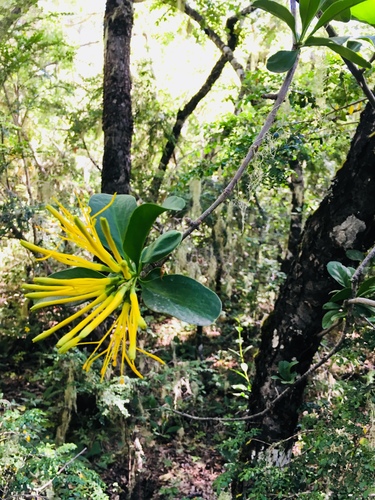
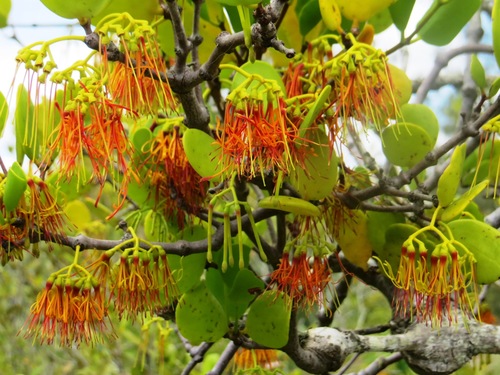
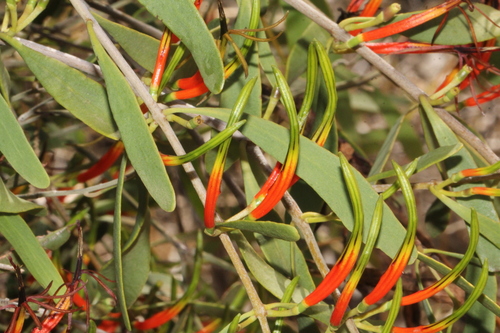
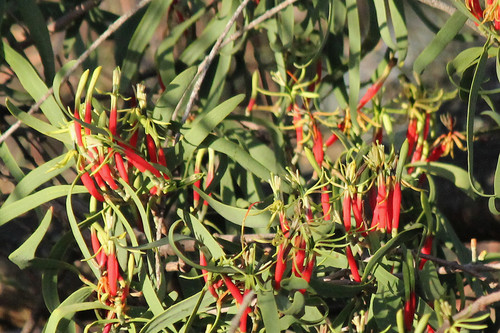
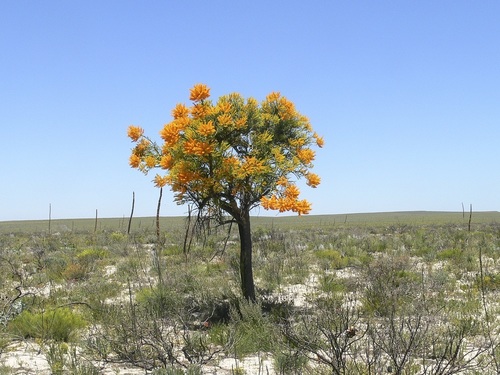
Nuytsia floribunda (Labill.) R.Br. may grow as a tree up to 10 metres (33 ft) high, or as a lower-growing shrub. It has rough grey-brown bark. Its vivid yellow-orange flowers appear between October and January, and the inflorescence on each flowering stem can reach up to 1 metre (3 ft) in length. This species is a photosynthetic root hemiparasite, which mainly obtains water and mineral nutrients from host plants. Haustoria growing from Nuytsia roots attach to the roots of many adjacent plants to draw water and nutrients from them. Almost all other nearby species can be attacked, and haustoria have even been found attached to underground cables. In natural environments, Nuytsia only withdraws a small amount of resources from each individual host, but it attaches to so many plants that the total benefit to the hemiparasite is likely considerable. Its roots and rhizomes spread outward and may sucker to form new branches, creating the appearance of a grove of trees. A network of fine, fragile roots grows from these larger underground structures, and forms haustoria when they contact the roots of other species. These roots or rhizomes can grow up to 150 metres (492 feet) in length, which is the most extensive root system of any known plant. The trunk can reach up to 1.2 metres in diameter, and is made of multiple layers of wood and bark that allow the tree to survive fire. An unusual feature of its seedlings is that they have four to six cotyledons, rather than the typical two. This species is well known in Southwest Australia, particularly for its abundant, spectacular summer flower display. It grows across a variety of soil types throughout Southwest Australia; its range extends east of the Esperance Plain and north onto the Geraldton Sandplains. It was once common across the Swan Coastal Plain, but most of its habitat around Perth has been cleared due to land use changes following European colonisation. While Nuytsia seeds germinate easily and seedlings can be grown successfully for one to two years, growing the species to maturity is considered difficult, and there has been little success cultivating it outside its native habitat. Nuytsia floribunda flowers produce large amounts of pollen and nectar that are eaten by insects. The parasitic relationship between Nuytsia floribunda and its host species was not well understood until botanist D. A. Herbert published an investigation with the Royal Society of Western Australia, which contradicted the earlier assumption that the species needed to grow near specific trees such as banksia and jarrah. Herbert discovered the extensive network of filaments that wrap around the roots of many other plant species, explaining why Nuytsia trees persist on agricultural land cleared for introduced crops. Multiple lists of both native and introduced host species vulnerable to attack exist, and evidence suggests Nuytsia can parasitise an extraordinarily wide range of taxa, with only one published record of a species (Adenanthos cygnorum) that appears immune. Its generalised method of attaching to host roots likely allows it to parasitise almost any root it comes into contact with. It was once common and well known on the coastal plain around Perth, often remaining in remnant bushland and gardens, and has become more scarce as urban development has increased in extent and density. Noongar people use this species during the season of kambarang (around October to early December), harvesting bark to make shields. The gum that exudes from the cut bark can be collected later; it is sweet and eaten raw. Flowers from the tree are traditionally used to make a sweet, mead-like beverage during birak. Nuytsia is considered a sacred and protected tree by the Noongar, it is included in their rituals and has a conservation status that forbids its destruction. Some people venerate the plant, holding that one should not sit beneath it, nor touch or remove its flowers, leaves or branches. The sugary gum is only eaten in small quantities; children are warned against overindulgence with a story of a monstrous, invulnerable, inescapable nocturnal being that cries "Nhervalong" as it collects the gum it feeds on. Seasonal use of the roots by other Aboriginal groups is also recorded. Ethel Hassell, at Jerramungup, was invited to taste roots being harvested by a group of women, and reported that the flesh beneath the easily removed skin was sweet, with a brittle and somewhat watery texture. The tree's wood is considered commercially useless, and cultivation and transplanting are difficult or impractical for gardens or landscaping. Western Australia's conservator Charles Lane Poole noted that the showy flower display is the species' only desirable quality, but also added that the exuded gum may be useful. Artist Marianne North featured the tree in an 1880 illustration titled Study of the West Australian Flame-tree or Fire-tree, now held at the Royal Botanic Gardens, Kew. She recorded her enthusiastic impressions: "I shall never forget one plain we came to, entirely surrounded by the nuytsia or mistletoe trees, in a full blaze of bloom. It looked like a bush-fire without smoke. The trees are, many of them, as big as average oaks in our hedgerows at home, …" Early settler George Fletcher Moore described this parasitic tree as another "anomaly in this land of contradictions". A journal of systematic botany published by the Western Australian Herbarium, Nuytsia, is named for this tree. The Annals of Natural History recorded in 1842 that a specimen was grown in a government garden in 1841, and that an attempt was made to raise the few seeds it produced. The published correspondence is credited to "H. Bidwell … of Sidney" [sic].