About Nuctenea umbratica (Clerck, 1757)
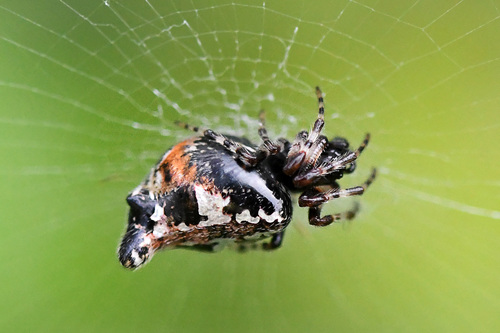
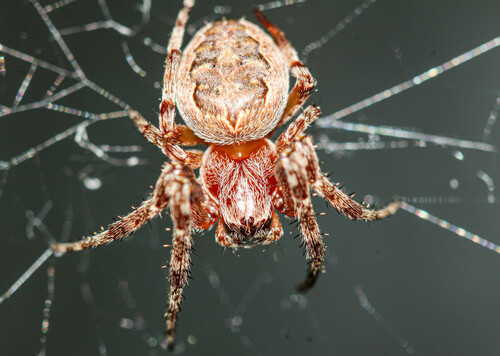
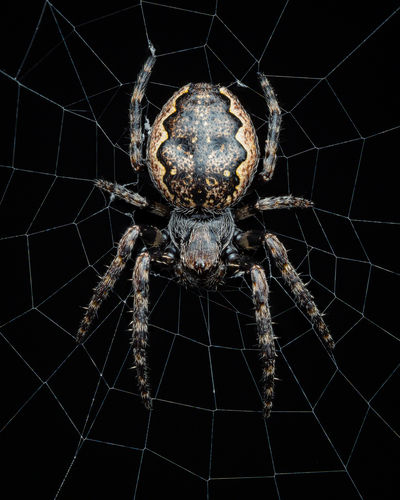
The walnut orb-weaver spider, scientifically named Nuctenea umbratica, has a very wide, flattened body with leathery skin. Its color varies from red-brown and grey-brown to black, and its opisthosoma bears a dark, yellowish to yellow-greenish leaf-like flecked marking. Small dents, visible on the opisthosoma, are the starting points of the muscles that flatten the spider's abdomen. Females of this species can grow up to 15 mm in body size, while males only reach a maximum size of 8 mm. This spider hides during the day in wall crevices outside of buildings, or under loose bark. It is very common in Central Europe; females can be found year-round, while males appear mostly in summer. The species' flattened body shape allows it to hide in cracks and crevices, and walnut orb-weavers can conceal themselves in very confined spaces. This trait acts as a defensive advantage, and also expands the range of locations where an orb-web can be successfully constructed. In the evening, the spider builds an orb-web that can reach up to 70 cm in diameter. A signaling thread runs from the web to the spider's hiding place, and after dusk the spider sits in the center of the web. There are three recognized subspecies of Nuctenea umbratica with their respective distributions: the nominate subspecies Nuctenea umbratica umbratica (Clerck, 1757) ranges from Europe to Azerbaijan; Nuctenea umbratica nigricans (Franganillo, 1909) is found in Portugal; and Nuctenea umbratica obscura (Franganillo, 1909) is also found in Portugal.