About Nucifraga columbiana (A.Wilson, 1811)
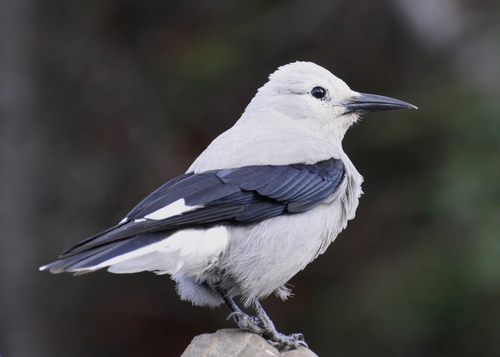
Nucifraga columbiana, commonly known as Clark's nutcracker, is roughly the size of a jay, and slightly smaller than its Eurasian congenerics: the northern, southern, and Kashmir nutcrackers. Gray feathers cover its head, back, belly, and ventrum, it has black wings with white tips on its secondary feathers, and its tail feathers are easily distinguishable when the bird is in flight: central feathers are black, and are bordered by white feathers on either side. It has a long, black, pointed bill, with a shape specialized for removing the scales of pinecones. This species occurs in western North America, ranging from British Columbia and western Alberta in the north to Baja California and central New Mexico in the south. There is also a small isolated population at the peak of Cerro Potosí, 3,700 metres (12,200 ft) in elevation, in Nuevo León, northeast Mexico. It mainly lives in mountains at altitudes of 900–3,900 metres (3,000–12,900 ft) in conifer forest. It is not typically migratory, but does make seasonal movements between higher elevations during the summer breeding season and lower elevations in the winter. Some populations of Clark's nutcracker remain at high elevations year-round if they have sufficient food caches. In years when pine mast production is particularly poor, Clark's nutcracker may leave its normal range and travel as far north as Alaska, and as far east as the Great Plains. Vagrants have been recorded as far east as Pennsylvania and Ontario. The most important food resources for this species are the seeds of pines (Pinus sp.), principally two cold-climate (high-altitude) white pine species with large seeds: whitebark pine (P. albicaulis) and limber pine (P. flexilis). It also eats seeds of other high-altitude pine species, including foxtail pine (P. balfouriana), bristlecone pine (P. longaeva), western white pine (P. monticola), and ponderosa pine (P. ponderosa). Douglas fir (Pseudotsuga menziesii) is one of the few non-pine conifers whose seeds Clark's nutcracker eats regularly. During migrations to lower altitudes, it also extensively uses the seeds of pinyon pines. The isolated Cerro Potosí population is strongly associated with the local endemic Potosi pinyon (Pinus culminicola). All Clark's nutcrackers have a sublingual pouch capable of holding around 50–150 seeds, depending on seed size, which helps the birds more easily transport seeds between caches. Clark's nutcrackers store seeds, usually in the ground for later consumption, in caches holding 1–15 seeds, with an average of 3–4 seeds per cache. They prefer cache sites on steep, south-facing mountain slopes, because snow melts earliest here each year. Depending on the cone crop and tree species, a single Clark's nutcracker can cache as many as 98,000 seeds per season. The birds regularly store more seeds than they actually need as insurance against seed theft by other animals such as squirrels, as well as against low availability of alternative foods. This surplus seed is left in the cache, and may germinate and grow into new trees. This storage behavior demonstrates the bird's long-term spatial memory: they can relocate seed caches with great accuracy up to nine months after the seeds were initially stored. Clark's nutcrackers are heavily dependent on food retrieved from caches throughout the winter, and will dig up caches even when they are buried under heavy snow. Tests of short-term pictorial memory tasks show that while nutcrackers have particularly adept spatial memories, their visual memory is unremarkable; the cognitive ability they use to recover caches appears to have specifically evolved for this purpose. Like other corvids, Clark's nutcrackers are opportunistic feeders, and their diet also includes a wide range of insect prey, rodents, nestling birds and eggs, amphibians, and carrion. In rare cases, they may attack and eat adult birds. At backyard bird feeders, they will take peanuts and suet. Clark's nutcrackers will also eat unattended human food in developed areas, and are known to some people as "camp robbers".