About Notogrammitis heterophylla (Labill.) Parris
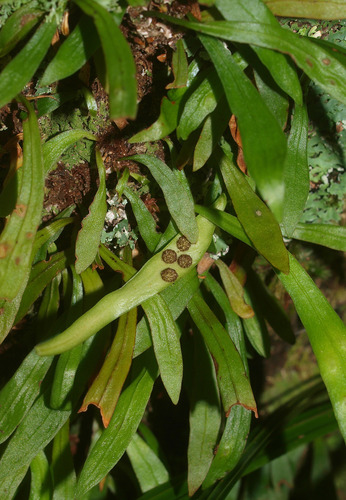
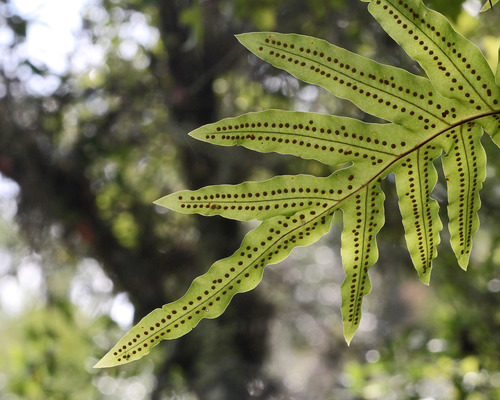
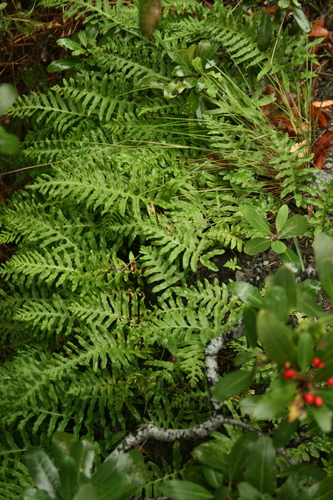
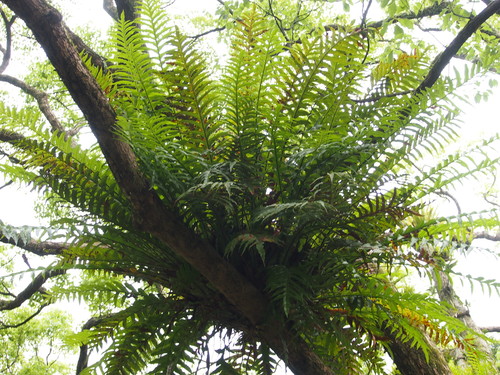
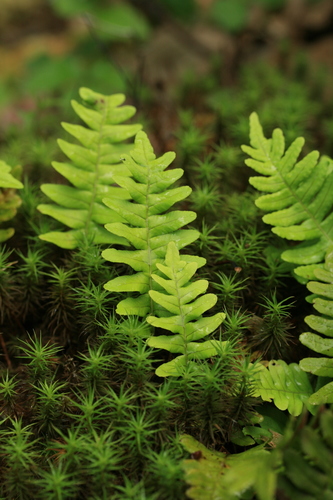
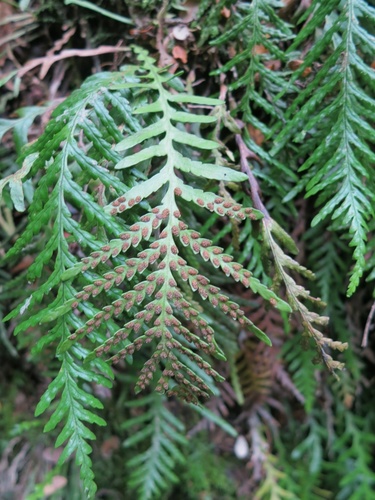
Notogrammitis heterophylla (Labill.) Parris is a species of comb fern that forms tufted patches. Both the upper and lower surfaces of its foliage range from dark green to light green. Fronds grow in two rows, and leaf margins are either entire, or bear primary and secondary lobules. This species produces between approximately 7 and 42 pairs of pinnae; the longest pinnae measure 3–60mm in length and 1.5–15mm in width. Globally, this species is native to New Zealand, and the Australian states of Tasmania and Victoria. Within New Zealand, it occurs across the North Island (in Northland, Auckland, Volcanic Plateau, Gisborne, Taranaki, and southern North Island), the South Island (in western Nelson, Sounds-Nelson, Marlborough, Westland, Canterbury, Otago, Southland, and Fiordland), and outlying coastal islands including the Chatham Islands, Solander Island, Stewart Island, and Auckland Islands. It prefers habitats ranging from coastal to subalpine environments. It is most often epiphytic (growing on other plants), but can also grow on cliff faces, forest boulders, and sheltered rocks within talus and scree. It can be found in beech, kauri, podocarp, and broadleaf forests, as well as coastal and subalpine shrubland, and under the canopies of mānuka and kānuka trees. Its life cycle starts when minute spores are dispersed by wind. After dispersal, spores develop into plants that grow from an erect rhizome. Established plants can grow in sites including clay banks, the base of trees, fallen logs, rock outcrops, open ground, wet cliff faces, and track and stream banks.