About Notocelia rosaecolana (Doubleday, 1850)
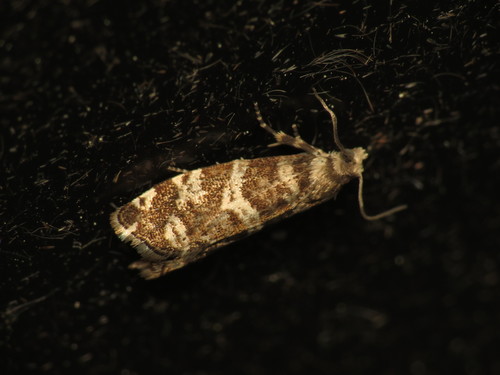
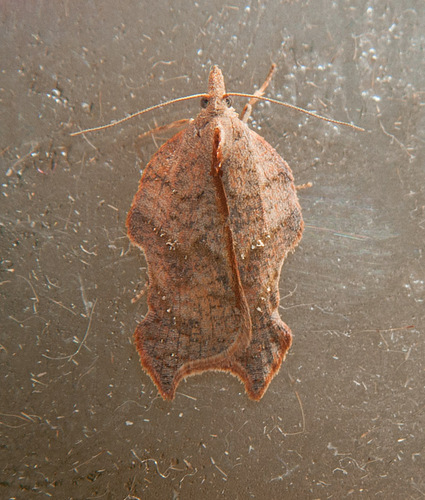
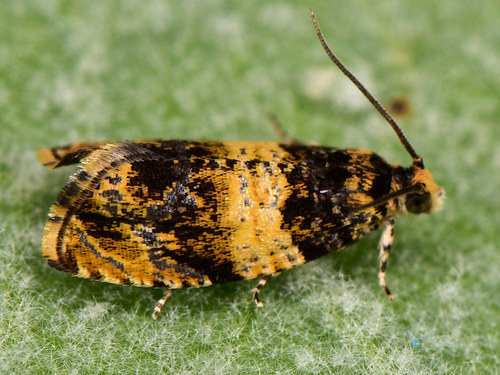
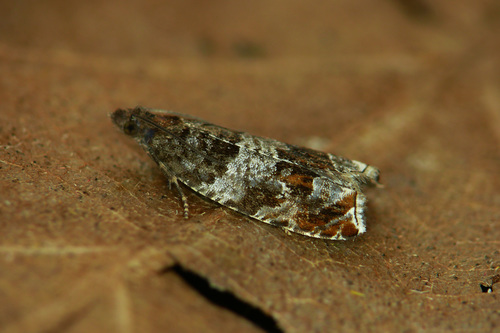
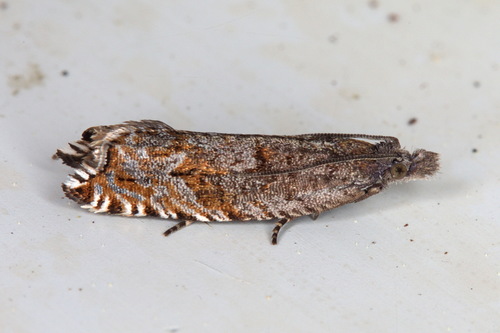
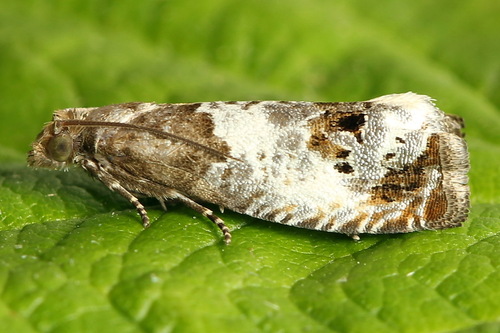
Notocelia rosaecolana, first described by Doubleday in 1850, is a species of moth belonging to the family Tortricidae. This moth is native to the Palearctic realm. Confirmed recorded locations for the species include multiple provinces across China: Beijing, Hebei, Liaoning, Jilin, Heilongjiang, Fujian, Jiangxi, Henan, Hubei, Hunan, Sichuan, Guizhou, Shaanxi, and Gansu. It has also been recorded in Mongolia, Korea, Japan, Iran, Central Asia, Russia, and Europe. The wingspan of adult Notocelia rosaecolana measures 15 to 20 mm. This species is visually very similar to two closely related moths: Notocelia trimaculana and Notocelia roborana. Its forewings are widened in shape, with a costa that has a moderate, even arch. The forewing fold does not extend to the middle of the wing. The base ground colour of the forewings is white. The costa is marked with fine dark fuscous streaks. The basal patch of the forewing is dark fuscous, with a rather rounded outer edge. This patch is followed by several grey markings positioned toward the costa and dorsum. The lower half of the central fascia is fuscous, marked with black spots, and is preceded by a single grey marking. The ocellus is bordered by a leaden-metallic colour, and encloses three or four distinct black dots. A series of brown or ferruginous and leaden-metallic streaks run toward the apex of the forewing. The hindwings are a uniform light grey. Full-grown larvae are purplish-brown on the dorsal side, and whitish on the underside. They have a brown head, and the dorsal plate on the second body segment is black. In western Europe, adult moths are active in flight from late May through August. The larvae of Notocelia rosaecolana feed on a variety of rose species, including Rosa multiflora, Rosa davurica, and Rosa rugosa.