About Notholithocarpus densiflorus (Hook. & Arn.) Manos, Cannon & S.H.Oh
Scientific name: Notholithocarpus densiflorus (Hook. & Arn.) Manos, Cannon & S.H.Oh
This tree can reach 40 meters (130 feet) tall in the California Coast Ranges, though 15–25 m (49–82 ft) is more typical, and it can have a trunk diameter of 60–190 centimeters (24–75 inches). Its bark is fissured and ranges from gray to brown. The average age of this tree is 180 years, though some individuals are estimated to be 300 to 400 years old.
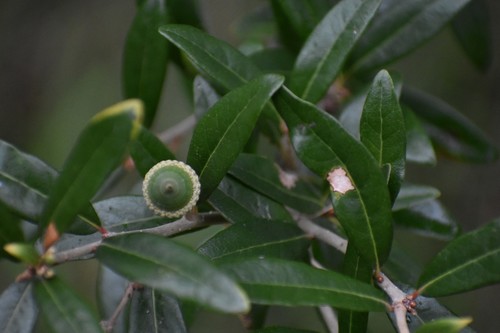
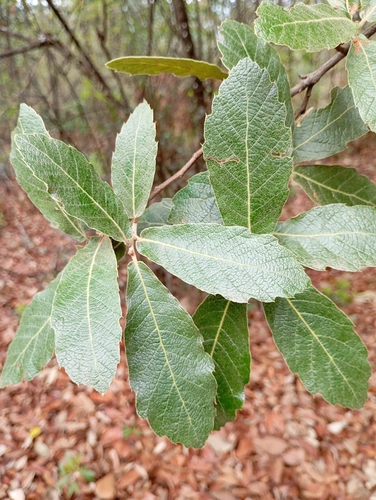
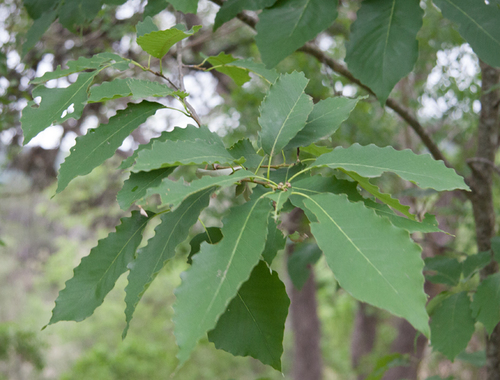
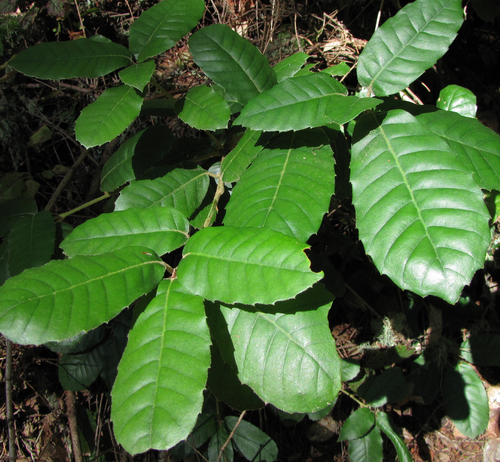
Its leaves are alternate, 8–13 cm (3–5 in) long, with toothed margins and a hard, leathery texture. When new, both sides of the leaves are covered in dense orange-brown scurfy hairs, which wear off over time, more slowly on the leaf underside. Leaves persist on the tree for three to four years.
As is typical for members of the Beech Family (Fagaceae), flowers are unisexual. This tree can flower during any season except winter, but most blossoms appear in June, July, or August, with coastal and low-elevation trees blooming the earliest. Small, solitary female flowers aggregate at the base of the erect male catkin, each with a small bract underneath. Pollination occurs via wind or insects.
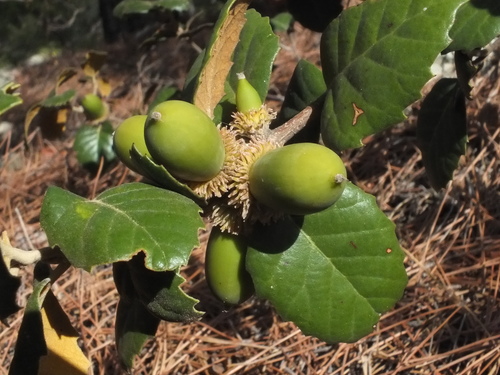
Its seed is an acorn 2–3.5 cm (3⁄4–1+1⁄2 in) long and 2 cm in diameter. It is very similar to an oak acorn, but has a very hard, woody nut shell more like a hazel nut. The nut sits in a cup during its 18-month maturation; the outside surface of the cup is rough with short spines. Nuts are produced in small clusters together on a single stem. Tanoak acorns have distinguishing hairy caps rather than scaly ones. Currently, the largest known tanoak specimen grows on private timberland near the town of Ophir, Oregon. It has a circumference of 7.9 m (26 ft), a diameter at breast height of about 2.51 m (8 ft 3 in), a height of 37 m (121 ft), and an average crown spread of 17 m (56 ft).
This species is native to the far western United States, found in southwest Oregon and in California as far south as the Transverse Ranges and east into the Sierra Nevada. It grows from sea level to elevations of 1,200 m (3,900 ft). Its range extends from near Santa Barbara, California, to just north of the Umpqua River of Southwestern Oregon. Inland, patchy populations occur throughout the Siskiyou Mountains and the southern tip of the Cascade Range, to the western slopes of the Sierra Nevada Mountains southwest of Yosemite Valley.
Tanoak is shade tolerant and benefits from disturbances. It is susceptible to wildfire and wounds that are exploited by rot fungi. It is one of the species most seriously affected by the disease "sudden oak death" (Phytophthora ramorum), with high mortality reported over much of the species' range. Fine hairs on young leaves and twigs discourage deer from eating them. Many different wildlife species depend on the large, oil-rich nuts for fattening up for winter, including band-tailed pigeons, squirrels, deer, elk, and bears. Tanoaks reduce erosion through their interwoven network of roots that quickly become established after disturbances such as logging. Tanoak leaf litter moderates soil temperature, restores soil texture, and increases microbial activity including nitrogen-fixing bacteria that improve soil fertility damaged by disturbance. Its deep roots move subsoil nutrients closer to the surface, where shallower rooted conifers can access them. Additionally, tanoak helps reduce threats to economically important conifers. Douglas-fir is harmed by laminated root rot, which tanoak and other hardwoods are immune to; during periods of tanoak dominance in the forest, disease problems of softwoods are reduced.