About Nothofagus menziesii (Hook.f.) Oerst.
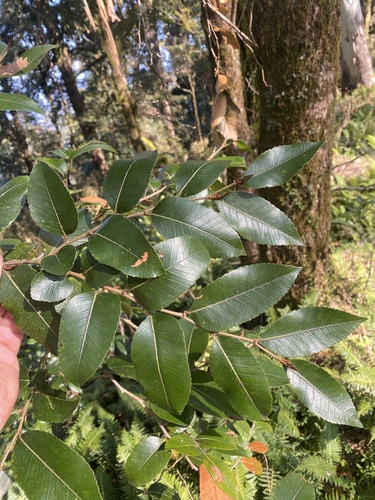
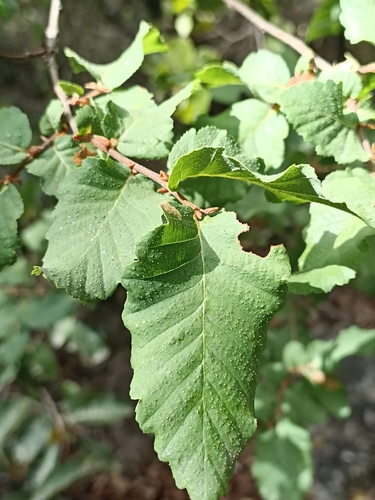
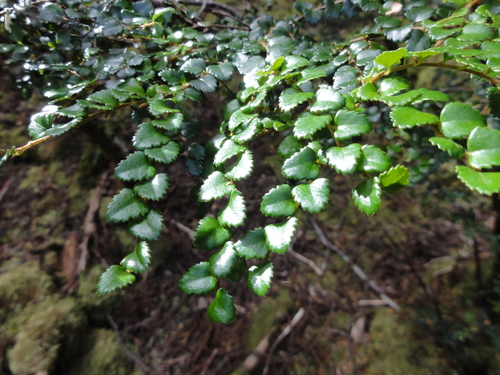
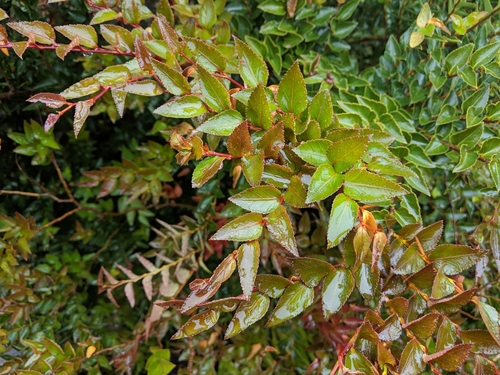
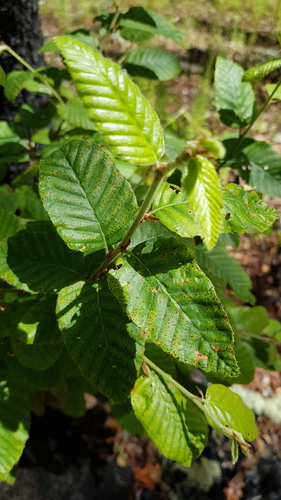
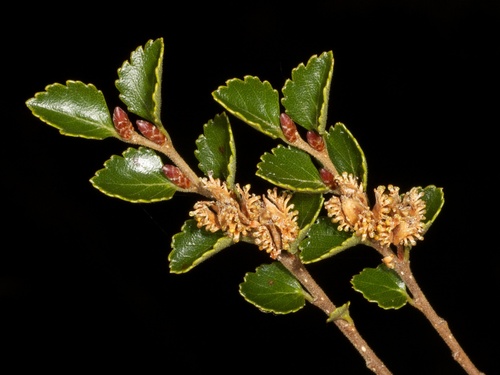
Nothofagus menziesii, commonly known as silver beech, is an evergreen tree in the family Nothofagaceae. It can grow up to 30 metres (100 feet) tall, with a trunk up to 1–2 m (3 ft 3 in – 6 ft 7 in) in diameter. In subalpine forests, it typically reaches 12 m (39 ft) in height with an 80 cm (31 in) diameter trunk. Most trunks are straight or slightly curved, supporting narrow crowns. When growing in open areas, however, individuals develop extensive branching closer to the ground, forming broad, spreading crowns. Young trees have smooth, silvery-grey bark marked by horizontal lenticels, which gradually becomes more furrowed as the tree matures. The species has an estimated maximum lifespan of 600 years. Its leaves are thick, rigid, green, and leather-like (coriaceous), measuring 6–15 mm long by 5–15 mm wide, with 2–3 mm long petioles. Leaf blades are smooth (glabrous) except for veins on the underside; they range from broadly triangular to nearly circular in shape, with double-toothed edges and a wedge-shaped base. Juvenile leaves are sometimes red. Cupules are 6–7 mm long, divided into 4 segments, bear 4–5 rows of gland-tipped projections, and are accompanied by 2 leaf-like bracts. The species produces slightly hairy (puberulous) nuts that measure 5 mm long. Lateral nuts are triangular (triquetrous), around 5 mm long, and range from pale brown to reddish-brown. Nut wings are tipped with glands and vary in shape: lateral wings are two-part or aborted, forming a triangular three-winged structure, while terminal wings are flat and two-winged with upward-extending wings. Each nut holds a single seed, which weighs around 4–5 mg and has narrow wings. Flowering occurs from November to January, and fruiting takes place from January to March. Nothofagus menziesii has a diploid chromosome count of 26. In male (staminate) plants, flower clusters (inflorescences) grow in groups of 1–4 per branchlet. Each inflorescence is held on a sparsely hairy 2–3 mm stalk that supports a single terminal flower. The perianth (floral structure) is 5–6 mm in diameter, made of 2 uneven lobes that each divide further into 2–3 segments. There are 30–36 stamens, with pollen-producing anthers that measure 2–3 mm, red at the top and greenish or straw-coloured below. In female (pistillate) plants, inflorescences occur 1–4 times per branchlet, holding 2–3 flowers on short, densely hairy stalks. Lateral flowers grow in groups of three, while terminal flowers grow in pairs or remain undeveloped; stigmas are elongated and strap-shaped. Female flowers grow at the tips of shoots, while male flowers develop on the lower sides of the same shoots. Flowers are presumed to be pollinated by wind. Nothofagus menziesii is endemic to New Zealand, with a widespread but discontinuous range across the North and South Islands. In the North Island, it is abundant in montane and subalpine forests across multiple mountain ranges, occurring only south of the 37th parallel. It does not grow naturally in the Taranaki Region or on Mount Taranaki. Smaller forest stands are found on the Ahimanawa Range, Kaimanawa Range, Kaweka Range, Mamaku Plateau, Mount Te Aroha, and the southwestern slopes of Mount Ruapehu. In the South Island, it is abundant from the Marlborough Sounds northwest to the Taramakau River, and west of a line through the valleys of Lakes Hāwea, Ōhau, Wakatipu, and Wānaka, extending to the Longwood Range and Takitimu Mountains. Isolated stands grow in the Westland Region near Otira, in the upper catchments of the Karangarua and Mahitahi rivers, and near the Poulter River and the Blue Mountains. Stewart Island, located south of the South Island across Foveaux Strait, has no native Nothofagus species. A 2020 DNA-based phylogeographic study of New Zealand Nothofagus published in the New Zealand Journal of Botany found that Pleistocene glacial cycles shaped the modern distribution of Nothofagus species, which are separated by areas known as "beech gaps". Compared to other New Zealand Nothofagus species, N. menziesii was found to be relatively genetically diverse, with nine identified haplotypes. The genetic data supported key phylogeographic insights that allowed testing of hypotheses about the origins and current distribution of N. menziesii forest diversity. The species has a broad altitudinal range from 0 to 1,280 m (0–4,199 ft) above sea level, growing in lowland and montane forests, with habitat varying by elevation and geography. The upper tree line for N. menziesii reaches 1,430 m (4,690 ft) on Mount Hikurangi, 1,200–1,280 m (3,940–4,200 ft) in the Tararua Ranges and Nelson, and 910–980 m (2,990–3,220 ft) in western Fiordland. In the North Island, the species is uncommon below 600 m (2,000 ft). Soils supporting N. menziesii forests vary widely, from shallow rock outcrops and coarse moraine to deep mineral soils and peats, and are typically classified as weakly to moderately weathered yellow-brown earths. Compared to related species, N. menziesii has lower tolerance for infertile and poorly drained soils. It is the slowest-growing but most cold-tolerant Nothofagus species native to New Zealand, able to withstand temperatures as low as −8 to −15 °C (18 to 5 °F). Kākā (Nestor meridionalis) occasionally visit N. menziesii trees, leaving deep scars on branches and trunks while searching for larvae of the pūriri moth (Aenetus virescens); this foraging behaviour was recorded for North Island kākā in Peter Wardle's species revision. Deer were introduced to New Zealand between 1851 and 1926, and frequently browse N. menziesii seedlings and young plants. Foliage of this species is the most commonly found food in the stomachs of both red deer (Cervus elaphus) and wapiti (Cervus canadensis), though it never makes up large quantities. Deer browsing across New Zealand often kills tree seedlings within forests. Seedlings growing in open areas tend to survive more successfully, and are better able to endure browsing, but frequently become densely hedged due to sustained grazing pressure. A 1958 study based on direct observation and stomach content analysis found no evidence that common brushtail possums (Trichosurus vulpecula) consume parts of N. menziesii trees, though Wardle's 1967 species revision recorded moderate browsing of its buds and leaves. Common brushtail possums have generally not been considered a threat to Nothofagus forests because they rarely feed on this species. Nothofagus menziesii trees serve as a host for three threatened endemic New Zealand mistletoe species: Alepis flavida, Peraxilla colensoi, and P. tetrapetala. Soils associated with N. menziesii support diverse fungal communities. Fungal diversity in canopy soil, including both ectomycorrhizal and non-ectomycorrhizal fungi, is lower than the diversity found in terrestrial fungi. New Zealand botanist G. H. Cunningham recorded many fungal species in the families Polyporaceae and Thelephoraceae that grow as saprotrophs on dead N. menziesii stems. Another study recorded ectotrophic species of the agaric genera Cortinarius and Inocybe associated with the species. A 2002 study published in the New Zealand Journal of Botany recorded 906 fungal taxa closely associated with New Zealand Nothofagus species, 56 of which are host-specialised to N. menziesii. Nothofagus menziesii is classified as one of the most flammable tree species in New Zealand. Its poor adaptation to resisting fire and reducing flammability indicates it has not evolved protective traits against fire. A 1987 ecological study of N. menziesii near Otira, led by botanist Peter Haase, found that after establishment, the species outgrows neighbouring trees and reaches greater canopy heights at maturity. This growth advantage is especially clear in montane and subalpine forests. Nothofagus menziesii undergoes periodic radial stand expansion over 300–500 year periods, gradually spreading into adjacent forests. Its average marginal spread rate is approximately 10 m (33 ft) per century. Seeds are dispersed by wind; botanist R. B. Allen found that seeds can travel up to 6 km (3.7 mi) from a parent tree. In 1988, Allen studied growth rates of N. menziesii in The Catlins. He found that most seedlings either grew past 35 cm (14 in) in height within 13 years or died, while a small fraction of suppressed seedlings stayed under 35 cm for as long as 25 years. The relationship between stem diameter and age was weak for stems over 10 cm (3.9 in) in diameter at breast height (DBH). Annual diameter growth rates varied widely between specimens, ranging from 0.30 to 8.52 mm per year. The timber of mature Nothofagus menziesii is valued in New Zealand for cabinet making and other uses. While the timber is considered a versatile general-purpose material, it is not typically durable for outdoor use. Even so, it is used for flooring, furniture, and panelling, and has also been used as pulpwood. Nothofagus menziesii was first cultivated in the United Kingdom in 1912, with cultivation starting at Tresco Abbey on the Isles of Scilly. It grows well in a range of UK climates, thriving in both the colder weather of Scotland and the warmer, drier conditions of Southern England. At Westonbirt Arboretum in Gloucestershire, N. menziesii grows steadily, though not with the same vigour as other Nothofagus species.