About Noronhia emarginata (Lam.) Poir.
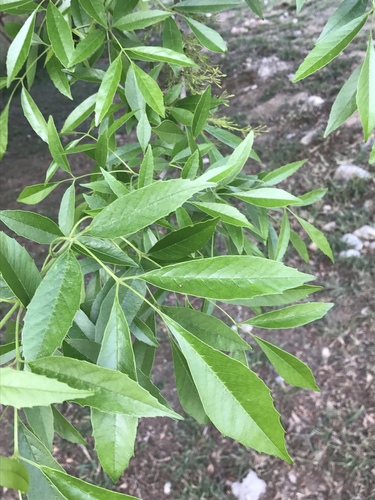
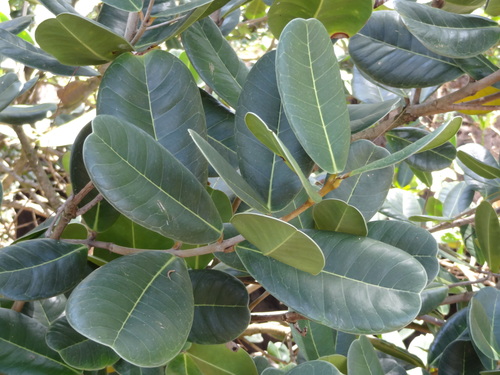
Noronhia emarginata, commonly called Madagascar olive, has the scientific synonym Olea emarginata Lam. It is a species in the Noronhia genus that is native to Madagascar, and is currently naturalized on Mauritius, Réunion, and Bermuda. This plant is an evergreen shrub or small tree that reaches 3 to 15 meters in height at maturity. It has smooth bark, stout round branches, and flattened terminal twigs. Its leaves grow in opposite arrangements, and are shaped elliptical or obovate; they can grow up to 16 centimeters long and 10 centimeters wide, with smooth unbroken margins and a notched emarginate apex. Its flowers are small, pale whitish-yellow, and fragrant, with a four-lobed corolla. The fruit is a drupe that ranges in shape from globose to turbinate, 2 to 3 centimeters in diameter, with a small pointed apex. Unripe fruit are bright yellow, ripening to dark purple; when dried, the fruit becomes hard, dark brown, and slightly rough, holding a single pear-shaped dark russet seed that is 10 to 12 millimeters long. The seed's cotyledons are unequal in size. Noronhia emarginata is cultivated as an ornamental tree in subtropical and tropical regions, and has become an invasive species in some areas, most notably Hawaii. It is very hardy in coastal and seaside locations, and has been successfully used for planting in urban areas where air pollution, poor drainage, compacted soil, and/or drought are common. It can grow in both part shade and full sun. It tolerates a range of well-drained soil types, including acidic or alkaline clay, loam, or sand. It has high drought tolerance, high aerosol salt tolerance, and moderate soil salt tolerance.