About Nolina texana S.Watson
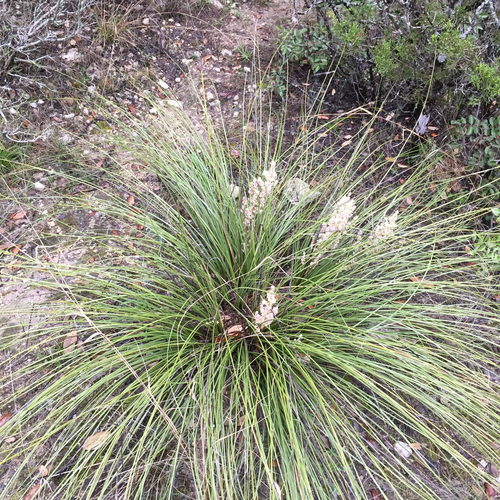
Nolina texana S.Watson plants strongly resemble clumps of grass, with many narrow basal leaves sprouting from the plant base and no visible stem (acaulescent). Each tuft grows from the top of a woody structure at the root crown called a caudex, which may branch underground, resulting in multiple rosettes per plant. The leaves of Nolina texana are stiff, wiry, and triangular in cross section. Basal leaves range 40 to 90 centimeters in length, and 2 to 7 millimeters wide at the base, usually measuring less than 4 millimeters wide. Leaves almost always have smooth edges and are not glaucous (not covered in wax); toothed edges are rare, and only occur at the leaf tips when present. The tips of fully grown leaves die back. The flowering stem, called a scape, grows directly from the underground caudex and curves at its end. The few leaves attached to the flowering stem curl toward their tips. The flower-bearing portion of the scape, the inflorescence, is repeatedly branched (paniculate), densely packed with flowers, and very occasionally purplish in color. The inflorescence measures 25 to 70 centimeters tall and 5 to 17 centimeters wide. The thicker side branches of the inflorescence grow outwards then ascend upwards. The small leaf-like bracts under each branch are 10 to 40 centimeters long and persist on the flowering stem through its entire lifecycle. The flowers of Nolina texana do not have clearly distinct petals and sepals, so their white, cream, or greenish-white structures are called tepals. The tepals are quite small, only 2.5 to 3.5 millimeters in length. Flowers have both fertile and infertile stamens; fertile stamens are typically longer, measuring 0.9 to 1.4 millimeters, while infertile stamens measure 0.6 to 0.8 millimeters. The fruit of Nolina texana is a thin-walled capsule measuring 3–4 millimeters by 4.5–8 millimeters. The capsules have three wings and usually split irregularly. The rounded seeds have a diameter of 2.6–3.4 millimeters. There is some uncertainty surrounding the range of Nolina texana. The very similar species Nolina greenei grows in Colorado, New Mexico, and Oklahoma, and it is unknown how many observations of Nolina greenei in these states were misidentified as Nolina texana. All sources agree Nolina texana is native to the U.S. states of Texas and New Mexico. The USDA Natural Resources Conservation Service PLANTS database additionally reports the species in Arizona, Oklahoma, and Colorado. Plants of the World Online (POWO) disagrees that Nolina texana grows in Arizona, but agrees it is native to Oklahoma and Colorado. With its wider coverage, POWO also reports Nolina texana grows in northern Mexico; the Global Biodiversity Information Facility specifically records it in Sonora, Chihuahua, Coahuila, Durango, Zacatecas, and San Luis Potosí, with the most frequent records from San Luis Potosí. Nolina texana grows in grasslands, shrublands, and rocky hillsides on soils derived from limestone or granite, at altitudes ranging from 200 to 2000 meters. Nolina texana is reported to cause sunburn (phototoxicity) by increasing blood phylloerythrin levels alongside liver problems. However, the specific chemical that causes this photosensitivity in the plant is unknown. Observational evidence indicates only the buds and flowers are significantly toxic. Commonly called Texas sacahuiste, this is the Nolina species most often grown in gardens. It is valued by gardeners for its evergreen foliage and flowers. It grows in full sun or partial shade, and is known to be resistant to deer browsing. For cultivation, Texas sacahuiste is often propagated by separating offsets. It requires alkaline soil and good drainage, and is winter hardy in USDA zones 7–11, tolerating temperatures as low as −15 °F (−26 °C).