About Noctua pronuba Linnaeus, 1758
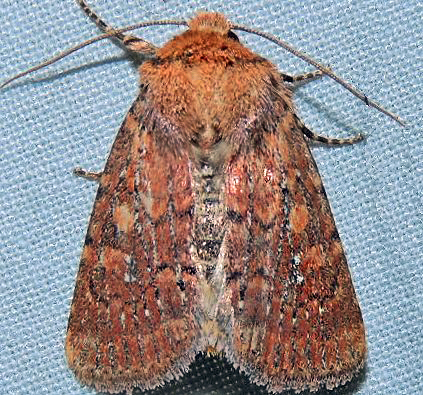
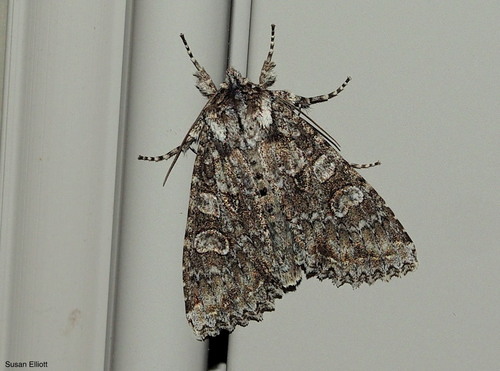
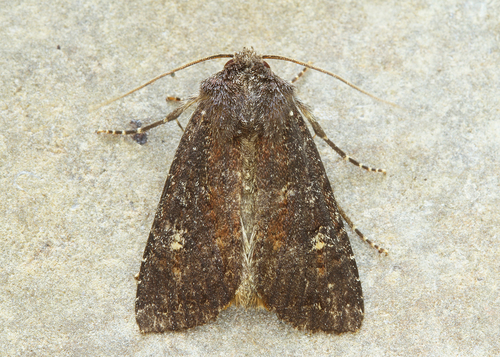
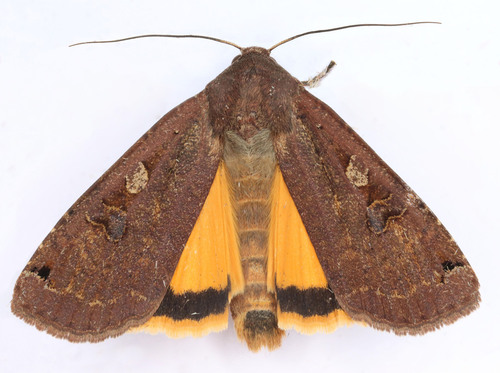
In the description by Meyrick, Noctua pronuba (Linnaeus, 1758) measures 48–56 mm. Males have ciliated antennae. Forewings range in color from ochreous-brown to dark fuscous, sometimes with a reddish tinge, and are sometimes partially irrorated with grey-whitish, particularly toward the anterior costa. The forewing lines are often paler with dark edges, and are sometimes faint; the subterminal line is preceded by a blackish mark on the costa. The orbicular and reniform spots are more or less pale-edged, outlined with darker color, and the reniform spot is partially marked with dark grey. Hindwings are ochreous-orange, with a blackish terminal band. Larvae range in color from pale green to dull brown; they have a pale dorsal line, a subdorsal series of blackish longitudinal marks on segments 5–12, a pale line below these marks, and a pale subspiracular line. The larval head is light brown with dark markings. Refer to Noctua orbona (lunar yellow underwing) and Noctua comes (lesser yellow underwing) to find differences between these species and N. pronuba. The stated flight season applies specifically to the British Isles, and may differ across other parts of the species' range. For recorded food plants, see the work of Robinson, G.S. et al.