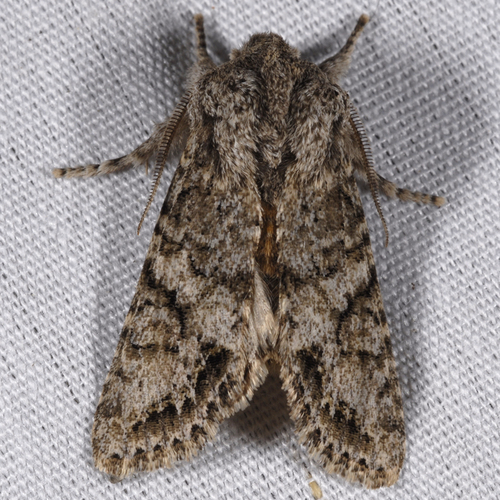
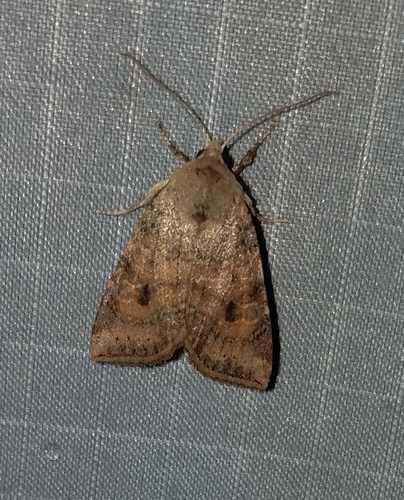
About Noctua fimbriata Schreber, 1759
Technical description and variation: The wingspan of Noctua fimbriata measures 45–55 mm, and the forewing length ranges from 22–27 mm. Forewing color varies by sex: it ranges from pale ochreous and rufous in females to red-brown and olive-green in males. Ochreous-colored males are rare. Markings on the forewing are faint in females and bold in males. The inner line of the forewing is dark, while the outer and submarginal lines are pale. The two upper stigmata are large, have pale edges, and often touch one another. A dark costal blotch sits before the submarginal line. The hindwing and its fringe are orange, with a very broad black border. Pale rufous specimens are classified as ab. rufa Tutt, and deep red-brown specimens are classified as ab. brunnea Tutt. Dark olive-green males are called solani F., while paler, more ochreous green specimens (likely males) are ab. virescens Tutt. A rare, distinct male form named ab. brunnea-virescens by Tutt combines deep red-brown and olive-green coloration. Specimens with blackish forewings are classified as obscura Lenz. The larvae are reddish ochreous, paler along the sides, and marked with brown spots. The dorsal line is paler, and a dark bar with pale edges crosses the 12th body segment. Spiracles are pale and sit on dark spots. Distribution: Noctua fimbriata is found across all of Europe, including the United Kingdom, and in parts of Asia. In Asia, its range extends east to the Caucasus, Turkmenistan, and Western Siberia (Novosibirsk Oblast). The species' type locality is in Germany.