About Noctua comes Hübner
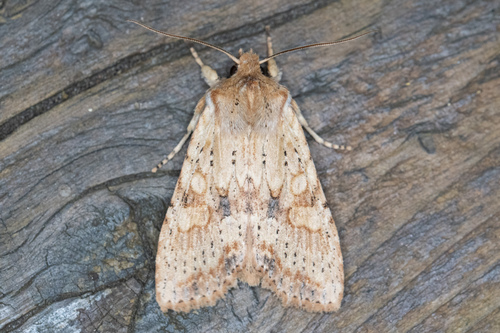
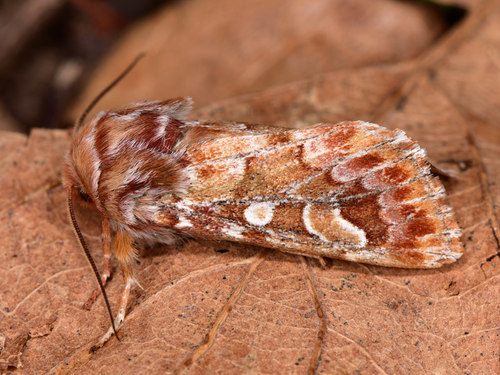
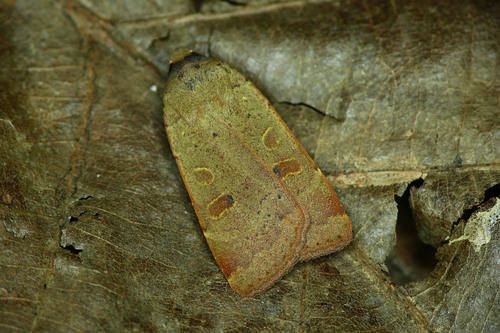
Noctua comes Hübner generally looks like a smaller version of the large yellow underwing, Noctua pronuba, with a wingspan of 38–48 mm. Its forewings are just as variable in pattern and colour as Noctua pronuba, ranging from pale clay to reddish clay, light brown to almost black. The stigmata are dark and outlined with pale yellow, while the crosslines are weak. The wavy line connects to the front edge as a stain that is at most dark brown, never black, and this stain sometimes extends the full length of the wavy line. The hindwings are orange-yellow with a broad black sub-terminal band and a central discal lunule, a feature that is usually absent in Noctua pronuba. This species is also similar to the lunar yellow underwing, Noctua orbona, and is overall a broad-winged moth. It flies at night from July to September, and is attracted to light and flowers such as heather, marram grass, and ragwort. Its larva is very similar to the larva of Noctua pronuba, being green or brown with black dashes along the back, but the two species have very different feeding habits. Unlike Noctua pronuba, Noctua comes is not a cutworm; instead, its larvae feed on the foliage of a wide range of plants, including trees, shrubs, and herbaceous plants. This species overwinters in the larval stage. It is found throughout the Palearctic realm, which includes Europe, North Africa, the Canary Islands, the Middle East, South Russia, the Caucasus, Transcaucasia, Turkey, Iraq, Iran, Afghanistan, north-west India, Novosibirsk, and Central Asia. It was introduced into British Columbia around 1982, and has since spread southward through the Pacific Northwest. It has recently been reported from Ontario, as documented by Crolla in 2008. Full synonymy for the species is provided by Lafontaine. It is a common species, but it is not as abundant as its larger relative, the large yellow underwing Noctua pronuba. Recorded food plants for Noctua comes include Betula (birch), Calluna (heather), Cirsium (thistle), Crataegus (hawthorn), Digitalis (foxglove), Fragaria (strawberry), Plantago (plantain), Prunus (blackthorn), Rumex (docks and sorrel), and Salix (willow). A full, cited plant list is available in Robinson, G. S. et al.