About Noccaea fendleri (A.Gray) Holub
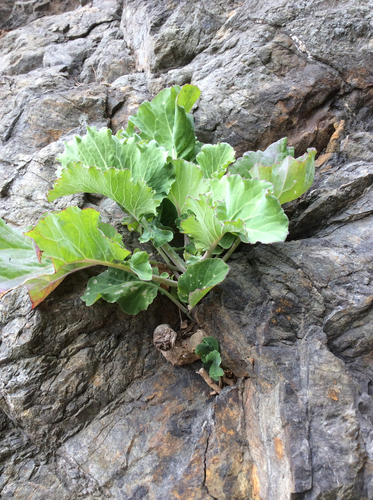
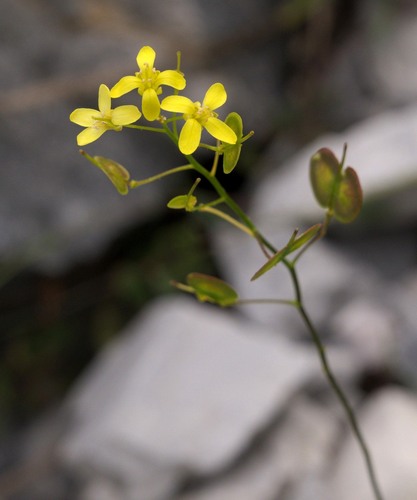
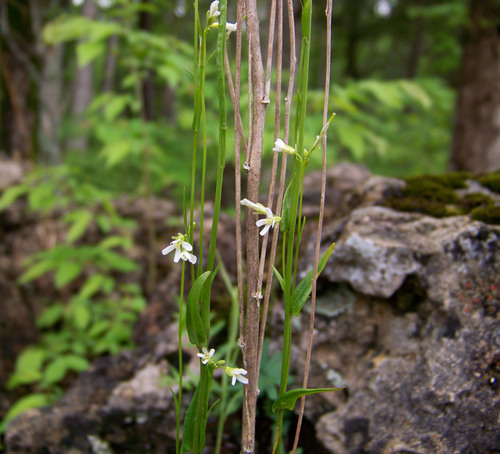
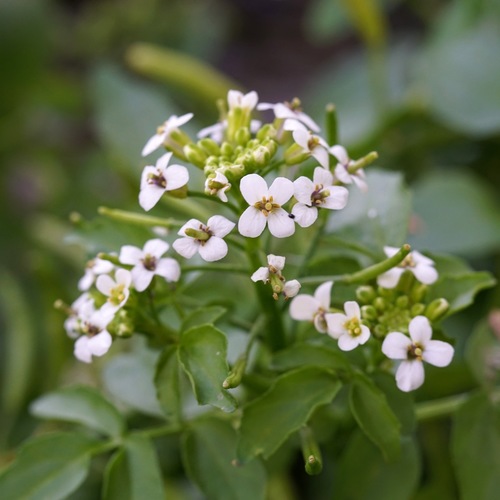
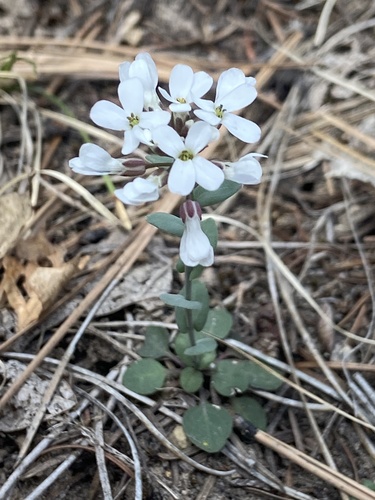
Noccaea fendleri is a small perennial flowering plant. It grows between 1 centimeter and 45 centimeters tall, most commonly reaching 4 to 32 centimeters in height. Its stems are either unbranched, or branched near their tips. It very often grows as a clump of multiple plants, but may also grow as a single rosette. Plants produce more basal leaves (leaves that grow directly from the plant's base) than stem leaves. The leaves are dark green with smooth edges, and are sometimes slightly purple. Leaf surfaces are smooth, hairless, and sometimes covered in a waxy glaucous coating. Basal leaves vary widely in shape: they may be narrow and grass-like (linear blade), a narrow rectangle with rounded corners (oblong), spearhead-shaped (oblanceolate), somewhat egg-shaped (ovate), teardrop-shaped with the stem attached at the narrow end (obovate), or spoon-shaped (spatulate). Basal leaves also vary in size, measuring 4 to 30 millimeters long and 2 to 14 millimeters wide. They attach to the plant base via a petiole that is 0.4 to 7.3 centimeters long. Stem leaves attach alternately along the stems, and their leaf bases partially wrap around the stem in a clasping arrangement. Each stem can hold between 2 and 21 leaves. This species blooms early in spring, though timing varies with local climate; its most common subspecies blooms from April to August. Its flowers typically have white petals and yellow centers, but petals are sometimes lightly tinged with purple or pink. Petals measure 4.2 to 13 millimeters long and 1 to 4.9 millimeters wide. The fruit is a pod called a silicle, formed from two fused carpels that split open when ripe. Silicles also have variable shapes, including teardrop-shaped (obovate), heart-shaped attached at the tip (obcordate), equilateral triangular (obdeltate), and elliptic (rounded with a point). The seeds are egg-shaped, brown, and 1.1 to 2 millimeters long. Noccaea fendleri is native to western North America, ranging from Washington and Montana in the United States south to Chihuahua, Coahuila, and Sonora in northern Mexico. It grows in alpine and montane ecosystems, and prefers rocky slopes and forest openings. Its most common subspecies, glauca, is found at elevations from 300 to 4400 meters. Also known as wild candytuft, this species is grown in native plant gardens for its butterfly-attracting white flowers. It is winter hardy in USDA zones 2 through 8, and adaptable to many soil types. It grows well in both full sun and partial shade, and tolerates drought conditions by becoming dormant.