About Noccaea caerulescens (J.Presl & C.Presl) F.K.Mey.
Scientific Classification and Growth Habit
Noccaea caerulescens (J.Presl & C.Presl) F.K.Mey. is a low-growing biennial or perennial plant.
Basal Leaf Structure
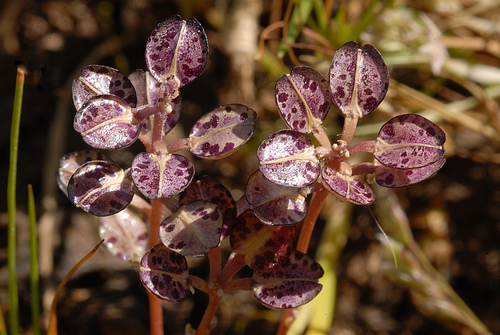
It produces small basal rosettes of stalked elliptic to lanceolate leaves that have smooth, unbroken margins.
Stem Leaf Structure
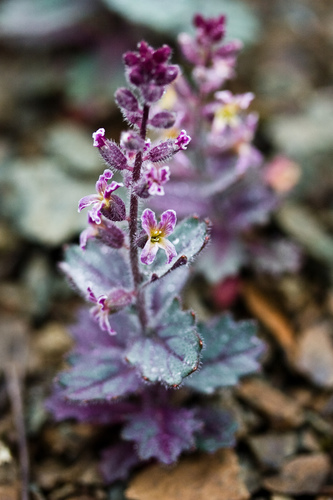
One or more flowering stems grow from the rosette, bearing small stalkless alternate leaves that clasp the stem.
Inflorescence Trait
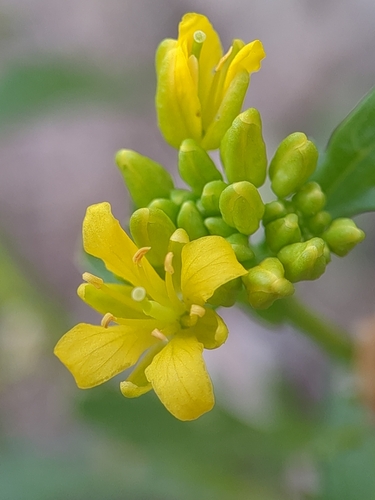
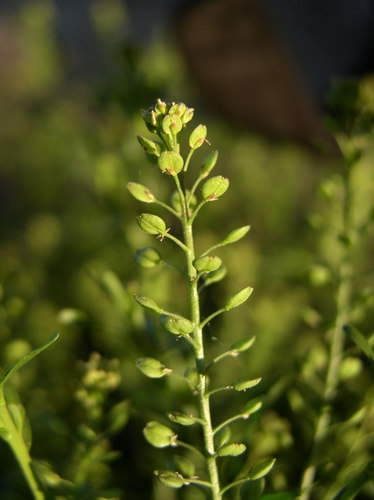
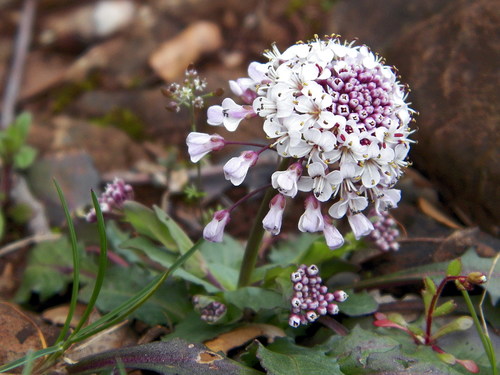
Its inflorescence is a dense raceme that continues to lengthen after flowering finishes.
Flower Size and Petal Color
Individual flowers are radially symmetrical, measure about 5 mm (0.2 in) wide, and have white or pinkish petals.
Flower Sexual Parts
Each flower has four sepals, four petals, six stamens (four long and two short) with violet anthers, and a single carpel.
Fruit Characteristics
The fruit is many-seeded, narrowly spatulate, and has a notched tip.
Flowering Period
This species flowers in late spring.
Nordic Distribution
In Europe, Noccaea caerulescens grows in Finland and Sweden, occurring in all regions except the most northerly areas.
Additional European Distribution
It can also be found in the Alps, the Massif Central, the Pyrenees, eastern Norway, southern Germany, and northern England.
Habitat Types
It grows in dry hillside meadows, forest margins, banks, gardens, lawns, pastures, field margins, yards, and open bare sites.