About Nitraria retusa (Forssk.) Asch.
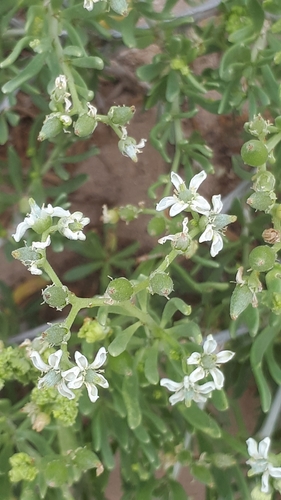
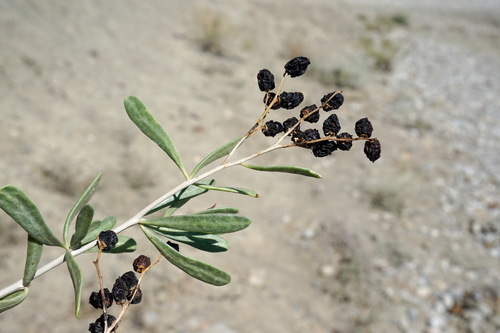
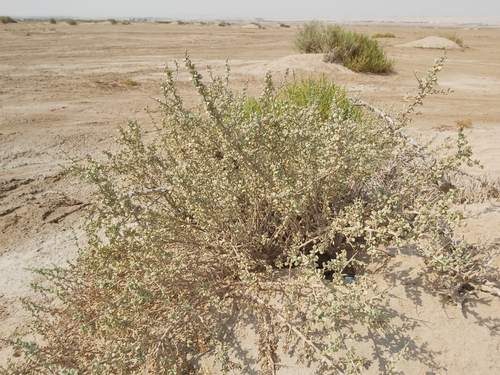
Nitraria retusa (Forssk.) Asch. is a shrub that reaches a maximum height of around 2.5 meters, or 8 feet. Young twigs are covered in fine fur, while the bluish-grey fleshy leaves are arranged alternately. Leaves are wedge or sickle-shaped with smooth, unbroken margins, and measure 10 to 15 mm (0.4 to 0.6 in) long by 8 to 10 mm (0.3 to 0.4 in) wide. Its small, sweetly scented flowers are whitish or greenish, have short stalks, and have floral parts arranged in groups of five. The fruit is a triangular drupe 5 to 10 mm (0.2 to 0.4 in) in diameter. This species is native to North and East Africa, the Arabian Peninsula, and the Middle East. It typically grows in salt marshes and semi-arid saline desert areas, and it contributes to stabilizing loose soils. It participates in primary succession on barren sand dunes. In the Moghra Oasis, Nitraria retusa plays an important role in sand dune stabilization. It is the dominant plant species in some zones here, forming mounds called nabkhas that develop when windblown materials accumulate at the base of the plants. This species has a wide range of tolerance for soil salinity and water availability. Near the lake where salinity is low and the water table is high, it grows alongside sea rush, common reed, salt grass, and Zygophyllum album. At the outer edge of the vegetated zone, where salinity is high and the water table is deep, it grows alongside Z. album and Nile tamarisk. Wild animals eat the fruit and help disperse the plant's seeds. The fruit turns red as it ripens, and is eaten by humans. Camels and goats graze on the plant's succulent leaves, and desert peoples have used the plant as a source of salt. Its wood is used for fuel, and the fruit is sometimes processed to make an intoxicating drink. Nitraria retusa is one of several salt-tolerant plant species currently being studied for potential use as a fodder crop for livestock.