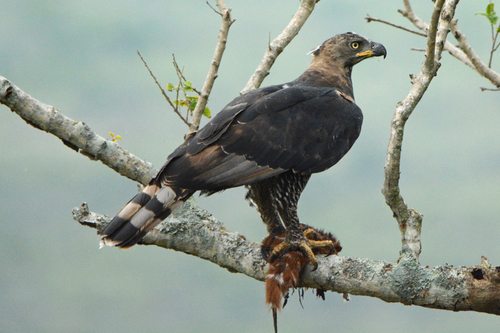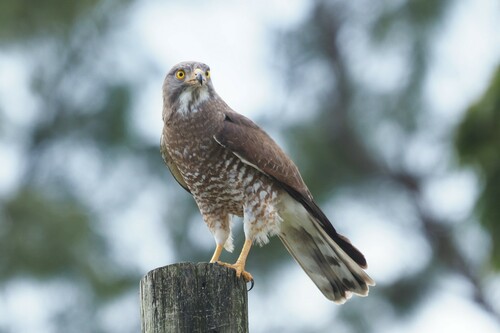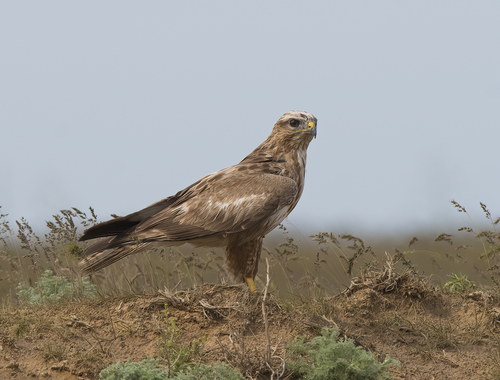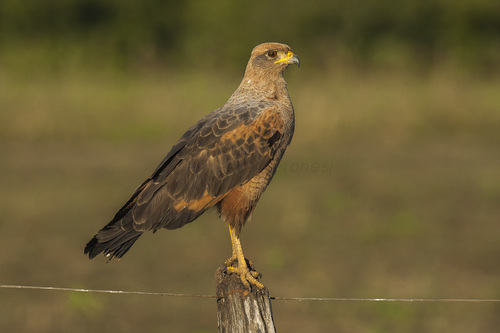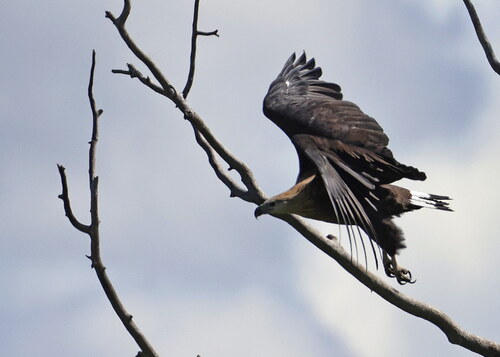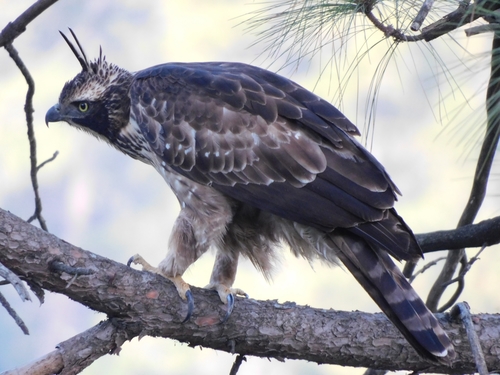
About Nisaetus nipalensis Hodgson, 1836
The mountain hawk-eagle (Nisaetus nipalensis), also called Hodgson's hawk-eagle, is a large bird of prey native to Asia. The common name Hodgson's hawk-eagle honors naturalist Brian Houghton Hodgson, who described the species after collecting an individual in the Himalayas. A less widely used common English name is feather-toed eagle. Like all eagles, it belongs to the family Accipitridae. Its feathered tarsus places it in the subfamily Aquilinae. It is a confirmed breeding species in the northern Indian subcontinent, ranging from India and Nepal (the source of its species epithet nipalensis) through Bangladesh to Thailand, Taiwan, Vietnam and Japan, though its breeding distribution may be wider than currently documented. Like other Asian hawk-eagles, this species was previously classified in the genus Spizaetus, but genetic studies showed this group was paraphyletic. As a result, Old World members were moved to the genus Nisaetus (Hodgson, 1836) and separated from New World species. As is typical of hawk-eagles, the mountain hawk-eagle is a forest-dwelling opportunistic predator that readily hunts a variety of prey including birds, mammals, reptiles and other vertebrates. While it is currently classified as a least-concern species due to its relatively wide distribution, the species is often rare and scarce, and its population appears to be decreasing, primarily in response to large-scale habitat degradation and deforestation. Both the northern and southern limits of this widespread raptor remain surprisingly poorly known to this day. Historic records indicate the species may reside hundreds of kilometers north of its currently accepted range, and there are year-round reports of the species in areas once thought to only host wintering migrant or vagrant individuals. The mountain hawk-eagle is distributed across the Himalayas, ranging from northeastern Pakistan through northern India (at minimum in the states of central Jammu and Kashmir, Himachal Pradesh and Uttarakhand), continuing through Nepal and Bhutan to northern Assam, then southward into the north and east Burmese highlands, western and peninsular Thailand, and the northern parts of Laos and probably Vietnam. Its range extends east into southeastern China, where it occurs in Yunnan, Guangxi and Guangdong Province, northward in the east to the lower reaches of the Yangtze in Anhui and Zhejiang, and also includes China's offshore island of Hainan. Mountain hawk-eagles are also found in the island nations of Taiwan and Japan, with the highest concentration on northern islands such as Hokkaido, though they may occur on nearly all Japanese islands. The species has been recorded as a rare breeder in areas much farther north than its conventionally accepted range, including far eastern Mongolia and the extreme southern landlocked part of the Russian Far East's Primorsky Krai. To date, the IUCN has not updated its range maps for the mountain hawk-eagle to reflect the species' presence in these areas, and confirmation of its status as a continuous breeding species here is still needed. Across most of its range, the mountain hawk-eagle is typically sedentary, but both adults and young sometimes disperse downhill from higher elevations in winter, so it can be characterized as a partial migrant. There are multiple recorded cases of the species wandering into the Indo-Gangetic plains from northern India. In Bhutan, fragmentary data suggests short-distance altitudinal movements are not uncommon, however relatively few migrant mountain hawk-eagles have been detected in Nepal. Mountain hawk-eagles in the northern part of southeast Asia fairly consistently range into more lowland areas of Burma, eastern Thailand and peninsular Malaysia. Similar movements to lowlands occur in Japan, and some Japanese individuals move to the Korean peninsula. In some of these areas, including Thailand and the far northern part of Malaysia, year-round records of mountain hawk-eagles suggest small, isolated pockets of residency and/or breeding exist. The mountain hawk-eagle has been recorded as a vagrant in Hong Kong and Cambodia, and one vagrant individual has been reported on the island of Borneo. The mountain hawk-eagle generally lives in dense hill and montane forests up to the tree line. It is mainly found in various wooded foothills. It typically prefers primary evergreen or mixed forests, and benefits from the presence of nearby streams. The core of its range falls in subtropical broadleaf forest that is cooled by high elevation, but it can live anywhere from temperate mixed forests to tropical rainforests. In some areas, it may also range into second growth. Outside of the breeding season, mountain hawk-eagles may sometimes wander through wooded plains and briefly near fairly developed (though usually more secluded and primitive) villages, and even near cities, though in Japan they reportedly entirely avoid woods near urban areas. In the Himalayas, the species generally lives at elevations of 600 to 2,800 m (2,000 to 9,200 ft) above sea level, but it has been recorded at up to 4,000 m (13,000 ft) in northern Yunnan. In Japan, it usually lives at lower elevations than its mainland counterparts, typically between 250 and 1,500 m (820 and 4,920 ft). Mostly only during winter, and rarely, the species has been recorded down to 200 m (660 ft) or even lower when it occurs as a vagrant. Mountain hawk-eagles are well adapted to living in forests. Like all Nisaetus species, their body shape and flight style are typical of forest-dwelling raptors generally, and are comparable to the features of true hawks, particularly larger accipiter species like the sometimes sympatric Eurasian Goshawk (Accipiter gentilis). Like most other forest raptors, mountain hawk-eagles (and Nisaetus species generally) have a long tail, short broad wings, and relatively long but powerful legs. All of these traits give greater maneuverability and quicker striking times in dense wooded hunting grounds than other raptor body plans. The common name hawk-eagle refers to these adaptations similar to true hawks. Some research has suggested that the mountain hawk-eagle's physiology—including longer wings and tarsus, but shorter talons and bill length when compared to Legge's hawk-eagle—indicates it is morphologically adapted to hunt birds more than mammals. However, dietary studies show the mountain hawk-eagle is not a specialized bird predator, but instead a generalist opportunist like many predators. In fact, the small number of existing dietary studies on this species show it somewhat prefers small mammals as prey, but will readily take birds and reptiles when the opportunity arises. Typically, the mountain hawk-eagle still-hunts from a concealed perch in foliage, then stoops down to capture prey. Most prey is captured on the ground. Mountain hawk-eagles have also been observed chasing passerines in flight after ambushing them or flushing prey by flying low at canopy level. They will also readily capture arboreal mammals and birds from perches or roosts if they can ambush them in flight. While most of their prey is relatively small, within the typical prey size range for most raptors, mountain hawk-eagles can capture remarkably large prey. As a result, Brown & Amadon (1986) described the species as markedly "rapacious and powerful". One study examined 118 prey items from several nests in southern Taiwan and found that giant flying squirrels were a surprising preferred prey. The Indian giant flying squirrel (Petaurista philippensis) and the red and white giant flying squirrel (Petaurista alborufus), both averaging about 1.65 kg (3.6 lb) in weight, made up 47.4% of prey items in Taiwan. It is unclear how they capture these elusive nocturnal rodents, but their relatively large size may make them more conspicuous from the hawk-eagle's high perch. A smaller true squirrel, the approximately 277 g (9.8 oz) Pallas's squirrel (Callosciurus erythraeus), made up an additional 19.5% of the average diet here. In total, 78.3% of prey taken in the southern Taiwan study was mammalian. The fourth most commonly taken prey was the 1.1 to 1.6 kg (2.4 to 3.5 lb) Swinhoe's pheasant (Lophura swinhoii), which made up an average of 6.7% of prey. A study in Hyōgo Prefecture, Japan examined 142 prey items from a single breeding pair. Most prey deliveries from this pair were surprisingly small in body size; it is unclear if this is typical for Japanese mountain hawk-eagles, as there is a lack of comprehensive study. About 17.5% of nest prey deliveries were unidentified small birds, with an estimated mass of 17.5 g (0.62 oz) (mostly brought by the male), while 7.7% of deliveries were unidentified medium-sized birds of an estimated 175 g (6.2 oz). Next was the merely 20 g (0.71 oz) Japanese shrew mole (Urotrichus talpoides), which made up 7% of prey deliveries, again mostly by the male. The most commonly delivered prey (18.2% of the female's 44 deliveries) after the female resumed hunting was large Elaphe snakes, over 100 cm (39 in) long and 325 g (11.5 oz). Overall, the estimated size of nest prey deliveries here ranged from a 5 g (0.18 oz) Japanese grass lizard (Takydromus tachydromoides) to several Japanese hares (Lepus brachyurus) with an estimated mean weight of 1.9 kg (4.2 lb); the latter likely made up a majority of the prey biomass. In another study, the mean weight of captured Japanese hares was estimated to be somewhat larger at about 2.5 kg (5.5 lb). In Jim Corbett National Park, India, prey reportedly consisted largely of small to medium-sized birds (which are likely larger than those in the Japanese study) including mynas, doves, parakeets, nightjars, owls and village poultry. In the Russian Far East, the most important prey types were reported as Manchurian hares (Lepus mandshuricus) (a close relative of the Japanese hare of the same size) and hazel grouse (Tetrastes bonasia), while the rest of the diet mostly consists of a mix of small mammals (moles, hedgehogs and flying squirrels) and larger forest birds (woodpeckers, pheasants and owls). Rare prey items recorded include amphibians, and fish has been recorded only once. While most prey mentioned is relatively modest in size, the mountain hawk-eagle is not infrequently reported to attack quite large prey, including prey equal to or larger than its own size. Mountain hawk-eagles have been reported to attack young ungulates, usually very small young individuals likely close to newborn size. In Taiwan, they take young Formosan serow (Capricornis swinhoei) estimated to average under 2 kg (4.4 lb). In Japan, they take similarly sized young wild boar (Sus scrofa) piglets that average about 1.75 kg (3.9 lb). Newborn sika deer (Cervus nippon) weighing at least 4.5 kg (9.9 lb) have also been recorded as prey in Japan. Scavenging on sika deer killed by human hunters has also been reported. The mountain hawk-eagle takes large avian prey, including adult Indian peafowl (Pavo cristatus) that weigh up to an estimated 4 kg (8.8 lb). In Echizen-Kaga Kaigan Quasi-National Park, Japan, mountain hawk-eagles have been recorded attacking only relatively large water birds on multiple occasions: the 1.12 kg (2.5 lb) mallard (Anas platyrhynchos), the 1.45 kg (3.2 lb) grey heron (Ardea cinerea), the 2.53 kg (5.6 lb) greater white-fronted goose (Anser albifrons) and the 2.77 kg (6.1 lb) bean goose (Anser fabalis). Carnivorans taken by mountain hawk-eagles can also be relatively large and potentially dangerous. A female preyed upon an estimated 1.8 kg (4.0 lb) kit of a Japanese badger (Meles anakuma). In Taiwan, four adult Chinese ferret-badgers (Melogale moschata) averaging about 1.3 kg (2.9 lb) were taken, and a Japanese marten (Martes melampus) of the same estimated weight was taken by a female hawk-eagle there. Sable (Martes zibellina) are also likely at risk from these birds. More impressive carnivoran prey killed by this species includes an adult yellow-throated marten (Martes flavigula) estimated at 2.75 kg (6.1 lb), an adult red panda (Ailurus fulgens) estimated at 4.5 kg (9.9 lb), and reportedly adult raccoon dogs (Nyctereutes procyonoides) that average 6.5 kg (14 lb), as well as occasional domestic cats (Felis silvestris catus) of a similar size range. Primates, which are similarly impressive in size and have a defensive temperament, are occasional prey of the mountain hawk-eagle. However, a large portion of primate prey such as monkeys are taken as infants or juveniles, and most but not all adults killed are probably previously injured or sickly. Even taking infant monkeys can present a risk to hunting hawk-eagles due to protective mothers and the monkey troop as a whole. For example, Formosan rock macaques (Macaca cyclopis) recorded as prey in Taiwan were all infants, estimated to weigh only 500 to 700 g (1.1 to 1.5 lb). A juvenile Assam macaque (Macaca assamensis) taken by a mountain hawk-eagle weighed an estimated 2 kg (4.4 lb). Possible predation on rhesus macaques (Macaca mulatta) has also been recorded in the Indian subcontinent. The mountain hawk-eagle is also considered a potential or confirmed threat to some larger primates (though largely or entirely to younger, more vulnerable members of their troops), including François' langur (Trachypithecus francoisi), black snub-nosed monkey (Rhinopithecus bieti), lar gibbon (Hylobates lar) and eastern hoolock gibbon (Hoolock leuconedys). The most impressive recorded primate kill was an adult Japanese macaque (Macaca fuscata) estimated to weigh between 8.3 and 10 kg (18 and 22 lb), which was captured alive and then dismantled by a large, presumably female, mountain hawk-eagle.