About Nisaetus cirrhatus (Gmelin, 1788)
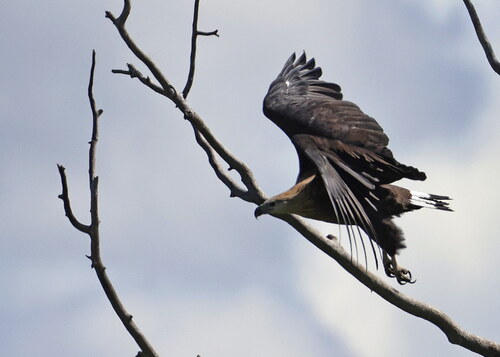
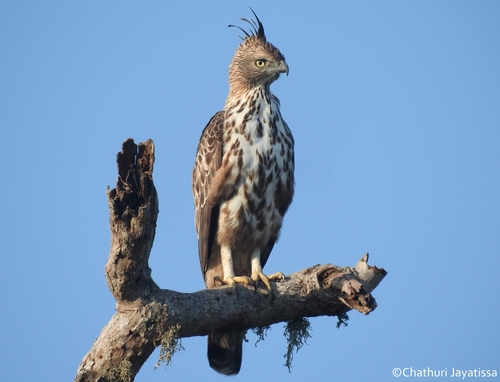
The changeable hawk-eagle (Nisaetus cirrhatus) is a largish but slender eagle, falling near the middle of the size range among currently accepted species in the genus Nisaetus. Like most birds of prey, females are larger than males, with an average overall size difference of 7%, which can range up to 18-22% individually. Island subspecies are thought to be less sexually dimorphic on average. Size varies considerably across the species. Past reports put total length from 51 to 82 cm (20 to 32 in) and wingspan from 100 to 160 cm (39 to 63 in), but these figures include the much larger Flores hawk-eagles, which modern authorities now classify as a separate species. Even so, total lengths of up to 77 cm (30 in) have been recorded for the subspecies N. c. limnaeetus in Nepal. Ali & Ripley (1978) estimated average total lengths for three subspecies: 72 cm (28 in) for N. c. cirrhatus, 70 cm (28 in) for N. c. limnaeetus, and 61 cm (24 in) for N. c. andamanensis. Legge (1880) measured Sri Lankan changeable hawk-eagles (N. c. ceylanensis), excluding the beak, at 55 to 60 cm (22 to 24 in). For Philippine individuals of N. c. limnaeetus, males averaged 58.4 cm (23.0 in) and females averaged 64.9 cm (25.6 in). Reported weights for the species range from 1.2 to 1.9 kg (2.6 to 4.2 lb), but the source of this range is unclear and it likely underrepresents the known size variation in the species. The only precise body mass data comes from the Philippine population, where males average 1.36 kg (3.0 lb) and females average 1.6 kg (3.5 lb), though individuals can weigh over 1.81 kg (4.0 lb). Adult changeable hawk-eagles are typically dark brown on the upper body and boldly streaked on the underbody. They have a strong bill, a variably sized (often floppy) crest that may also be absent, rather short wings, a quite long thinly-barred tail, and long feathered legs. This species perches bolt upright, and may perch anywhere from relatively secluded spots to quite open areas. When perched, their wings only reach about one-third to halfway down the tail. Pale morph adults are mainly dark brown above, with very faint paler edges that are usually only noticeable on the wing-coverts. They typically have an evenly black-streaked head and neck with a slight rufous tinge, and a blackish crest if one is present. The tail is paler brown than the back, with a thin whitish tip, a broad blackish subterminal band (both visible from the underside of the tail), and 3 to 4 narrower, brown and often rather obscure bars. On the underside of pale morph individuals, the base color is white to buff, overlaid with bold black to dark brown streaking; streaking is more subtle on the abdomen and more distinct on the legs. Beyond the common pale morph, some subspecies (especially N. c. limnaeetus) also have intermediate and dark morphs. The intermediate morph is similar to pale morph adults, but is heavily grey-brown below with little to no visible paler base color and more obscure streaking, with the area from the belly to the crissum usually unpatterned. Dark morph adults range from all dark chocolate brown to almost pure black with variable browner edges, only broken up by the greyish inner half of the tail and some greyish tail bars. Most juvenile changeable hawk-eagles are dark brown above, but have far more prominent white edges on the mantle and wings than adults. In some cases, the median coverts are largely white, and the greater and even lesser coverts are largely scaled with white. Juveniles have a light brown tail with about seven thin dark bars and a whitish tip. The juvenile’s head ranges from buff with a white-tipped black crest (seen in peninsular India and Sri Lanka) to entirely whitish, but almost all young birds have black or dark brown spotting and streaking on the rear crown and nape. Like the head, underparts are variable: juveniles across most of India and Sri Lanka have thin brown streaks on the chest or small spots on the breast, with obscure tawny barring on the thigh, legs and crissum, while juveniles from other regions are often nearly entirely pure whitish below. By the second to third year of age, young hawk-eagles tend to have less white on the upper body and more brown or black on the underbody. Their tail begins to molt to match the adult tail pattern by the third year, or by the second year for N. c. limnaeetus (at least in the Philippines). Changeable hawk-eagles may attempt to breed at 3 years of age, but full adult plumage is not gained until the fourth year. Adults have yellow to orange yellow eyes, while juveniles have grey-brown to pale greenish eyes. Adults have a grey to pale greenish yellow cere, and juveniles have a dull greyish cere; all age groups have yellow feet. In flight, the changeable hawk-eagle is a large raptor with a prominent head, rather short rounded and broad wings, and a longish squarish or rounded tail. Compared to sympatric hawk-eagle species, it has somewhat slenderer wings and straighter trailing edges. It flies with fast, agile movement, using powerful shallow wing beats interspersed with glides on flat or bowed wings, with carpals held well forward (above the level of the bill) and primaries swept back. When soaring, the wings are gently lowered or sometimes held level, with carpals still held well forward. For pale morph adults in flight, the hand may range from dark brownish buff (as in peninsular India) to much paler buff or whitish. On the flight feathers, the area from the wingtips extending to the primary and secondary feathers often has blackish barring, forming ragged lines from the carpals to the rear axillaries, with other variable dark marks elsewhere. Adult intermediate morph hawk-eagles have similar flight feathers but have grey-brown underparts with a less distinct contrasting under-pattern. For both juvenile and adult dark morph individuals, the blackish-brown body color extends to the hand, but the base of the tail, the primaries, and to a lesser extent the secondaries are a much paler contrasting grey, with streaking matching other changeable hawk-eagle morphs. Typical juveniles show large areas of whitish streaking or mottling when seen from above in flight. Juveniles from most of India and Sri Lanka have extensive darker tawny but obscure barring above and below, while other subspecies are much whiter. Just like adults, juveniles have dark tips on primary and greater coverts that form thin ragged diagonal bars, though the barring tends to be thinner. The changeable hawk-eagle has an extensive range covering much of the Indian subcontinent and Southeast Asia. Its distribution includes the Garhwal Himalaya to Assam, southern Nepal, Bhutan, Sri Lanka, and extends east through Myanmar, Thailand, Peninsular Malaysia, western Laos, southern Vietnam, and Cambodia. In India, it occurs almost continuously from the tip of the peninsula north to Rajasthan, Uttar Pradesh, Bihar, Odisha, and the Andaman Islands. In Indonesia, it is found in Sumatra, Simeulue and Mentawai off the west coast, Riau, Bangka Island, Belitung, Java, and Borneo; in the western and southern Philippines, it occurs on Palawan, Calamian Islands, Lubang Island, Mindoro, Mindanao, and Bohol. The changeable hawk-eagle inhabits savanna woodland, agricultural land, wetlands, tea plantations, forest villages, and even suburbs. It also ranges through open or less dense areas of undisturbed large evergreen forests, tropical and subtropical dry broadleaf forests, as well as secondary forests. In terms of elevation, it can be found anywhere from sea level to 2,200 m (7,200 ft), but mainly lives below 1,500 m (4,900 ft). Changeable hawk-eagles are well-adapted to a variety of wooded and semi-open habitats. Their physical form and flight style are typical of forest-dwelling raptors, and are often compared to the traits of true hawks (Accipiters), particularly larger species like goshawks. Like most other forest raptors, changeable hawk-eagles (and Nisaetus species generally) have a long tail, short broad wings, and relatively long but powerful legs. All these traits give greater maneuverability and quicker strike times in dense wooded hunting grounds compared to other raptor body types. The common name "hawk-eagle" refers to these similar adaptations to true hawks. Compared even to the variable prey of large goshawks, the prey selection of changeable hawk-eagles is somewhat indiscriminate and opportunistic. Unfortunately, compared to tropical raptors from the Neotropics and especially Africa, the life histories of tropical Asian raptors are generally quite poorly studied, even for easily observed species like the changeable hawk-eagle. What is known about the dietary biology of changeable hawk-eagles is largely compiled from reliable eyewitness accounts, anecdotes, photographic evidence, and broad bird census surveys, rather than direct extensive study. The changeable hawk-eagle may show a slight preference for birds as prey, but also freely takes various mammals, reptiles, and other vertebrates when the opportunity arises. While little quantitative analysis has been done on their dietary habits, most prey items taken are relatively small. On the other hand, Brown & Amadon's (1986) description of this species as "not a very rapacious bird" is not entirely justified, as the changeable hawk-eagle can readily take extremely large prey relative to its body size. Like many tropical forest raptors, it is primarily an ambush predator that uses concealing foliage to still-hunt from a hidden branch or an open branch with a leafy background, pouncing quickly to catch most prey on the ground. Like goshawks, changeable hawk-eagles often hunt from perch to perch: they make short, low-level flights between perches interspersed with brief pauses to scan for potential prey. Perch-hunting is most successful when hunting birds that they capture in the trees. At least a few observations have recorded changeable hawk-eagles watching for prey and dropping directly onto it from their own nest. One of the only general quantitative analyses of the changeable hawk-eagle’s food preferences (though detailed prey species breakdowns were not included) was a study comparing this species with five other raptor species in Maharashtra, India. The study found that changeable hawk-eagles preferred birds as prey, with nearly equal numbers of small and large birds making up nearly half of their diet across 14 active territories. Their prey class selection was found to be somewhat similar to that of Bonelli's eagle (Aquila fasciata), an eagle that occupies much more open and rocky habitats, but the changeable hawk-eagle had the highest prey class diversity of any of the six raptors studied, and was the only one that hunted near heavily wooded areas. In West Java, primary prey by class differed: 62% of selected prey was reptiles, 24% was birds, and 12% was mammals. Elsewhere in India, prey selection studies at nests have recorded which prey species were taken, but lack quantitative data or analysis of prey biomass. A study in Gujarat found that mostly small prey species were taken, including the Indian chameleon (Chamaeleo zeylanicus), Oriental garden lizard (Calotes versicolor), other lizards, common myna (Acridotheres tristis), red-vented bulbul (Pycnonotus cafer), other birds (including unidentified parakeets and gamebirds), Indian bush rat (Golunda ellioti), and a palm squirrel. The identified prey ranged in weight from 35 g (1.2 oz) for a garden lizard to 117 g (4.1 oz) for a myna, with small lizards and chameleons reported as the most frequently delivered prey. In Mudumalai National Park, only three prey types were identified to genus: black-hooded oriole (Oriolus xanthornus), common bronzeback snake (Dendrelaphis tristis), and an unidentified giant squirrel. Not all nests contain only relatively small prey: one nest in northern India had a prey composition including red junglefowl (Gallus gallus), large woodpeckers such as flamebacks, and larger parakeets. Alongside various junglefowl and domestic chickens derived from them, almost any gamebird appears to be ideal prey for changeable hawk-eagles. Several gamebird species, including peafowl, bush quail, spurfowl, and francolins, are known to be hunted, including both young and adult individuals. Many other birds with partially terrestrial habits are widely taken, including various pigeons and doves, rails, and other water birds. The upper size limit for the changeable hawk-eagle’s prey is fairly flexible, and the species is just as capable as other booted eagles of making bold attacks on prey of its own size or larger. Many mammals reported as prey are quite large. Adult mammalian prey includes hispid hares (Lepus hispidus) with a median estimated weight of 2.35 kg (5.2 lb), Indian hare (Lepus nigricollis) with a median mass of 2.7 kg (6.0 lb), 1.3 kg (2.9 lb) Indian flying fox (Pteropus giganteus), and almost any species of giant squirrel, which can weigh between 1.1 and 3 kg (2.4 and 6.6 lb). Even more impressive accounts and photos show that changeable hawk-eagles can hunt and kill adult mammals with formidable defenses such as felids and primates, though it cannot be ruled out that they usually attack infirm or injured specimens rather than healthy ones. Furthermore, most accounts of attacks on Old World monkeys show that juveniles are by far the most vulnerable members of troops to hawk-eagle attacks. Verified, likely, or potential predation has been reported on northern pig-tailed macaque (Macaca leonina), crab-eating macaque (Macaca fascicularis), toque macaque (Macaca sinica), and lion-tailed macaque (Macaca silenus), including specimens that may weigh up to an estimated 6 kg (13 lb). A case of predation by a changeable hawk-eagle on an estimated 1.9 kg (4.2 lb) juvenile banded langur (Presbytes femoralis) was photographed, while possible cases have been reported of predation on juveniles of other langurs and additional larger primates such as gibbons and proboscis monkeys (Nasalis larvatus). While the predator-prey relationship is even less clear, the peculiar, smaller but toxic nocturnal primates known as slow lorises are known to fall prey to changeable hawk-eagles as well. There are several accounts of changeable hawk-eagles preying on domestic cats (Felis catus), though mostly kittens, in addition to one case of a large adult jungle cat (Felis chaus), with an estimated median weight of 7.3 kg (16 lb), being attacked and killed by one of these hawk-eagles. The changeable hawk-eagle is also counted among the predators of calves of Indian gazelles (Gazella bennetti). Adults of large monitor lizards of several species may also be included in its prey spectrum. Avian kills include adult Indian peafowl (Pavo cristatus), with an estimated weight of up to 4 kg (8.8 lb), and the species is considered a threat to the similar green peafowl (Pavo muticus) as well. Attempted predation on both 4.2 kg (9.3 lb) adult and young giant ibis (Thaumatibis gigantea) has been recorded, but all known attacks were unsuccessful. Cases of scavenging on carcasses of various deer and monkeys have also been reported; in one case, a hawk-eagle was filmed chasing an adult yellow-throated marten (Martes flavigula) away from a carcass. Changeable hawk-eagles have also been observed preying on Oriental pied hornbills (Anthracoceros albirostris). The habitat selection and overall distribution of the changeable hawk-eagle largely overlaps with that of other largish raptors such as the crested serpent eagle and the crested honey buzzard, and the three species are largely tolerant and non-aggressive towards each other, which is perhaps surprising given the otherwise aggressive habits of hawk-eagles. Unsurprisingly, these species have quite different ecological niches, especially in terms of dietary habits. Although nest predators are likely abundant, parent changeable hawk-eagles will likely aggressively displace most potential threats. No verified accounts of predation on adult changeable hawk-eagles are known in the wild, and the species often likely acts as an apex predator. It presumably coexists with larger cousins such as mountain hawk-eagles and Legge's hawk-eagle by focusing more on reptiles and birds rather than the mammalian prey likely preferred by the larger species (as well as primarily focusing on smaller prey), and it is also more adaptable in terms of habitat than both of those species. It is also found living alongside the much larger Philippine eagle (Pithecophaga jefferyi), and likely similarly takes smaller prey and avoids direct encounters with the less numerous giant eagle. In turn, changeable hawk-eagles are likely avoided by smaller forest raptors such as other smaller Nisaetus species (which focus slightly less on birds than the changeable hawk-eagle) and Accipiter hawks, which all feed largely on much smaller prey classes. Changeable hawk-eagles are considered likely predators of the slightly smaller Indian spotted eagles (Clanga hastata). However, one case of predation was recorded in captivity when a barred eagle-owl (Bubo sumatranus), which occurs in the wild alongside changeable hawk-eagles in Southeast Asia, killed a changeable hawk-eagle in an aviary.