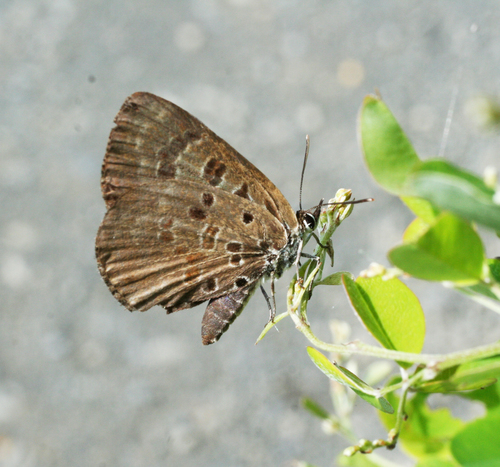
About Niphanda fusca (Bremer & Grey, 1853)
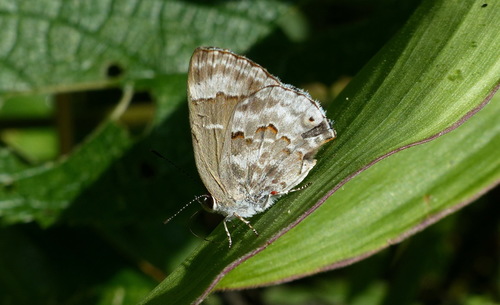
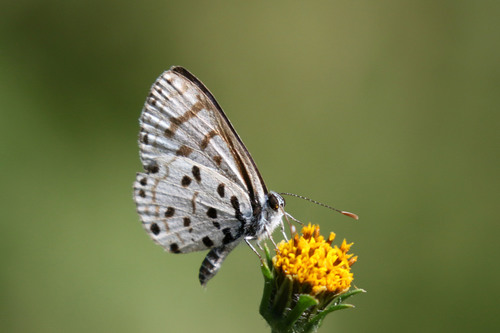
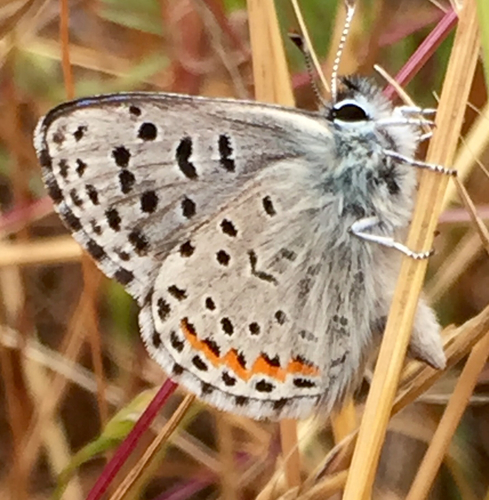
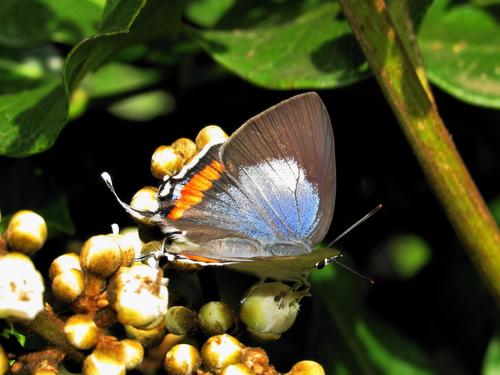
This butterfly species, Niphanda fusca, has broad spotted wings, with larger, more prominent patterns on its forewings. Its overall body color is beige-gray, and its spotted patterns are dark brown. Observed male individuals have gray underwings. Adult N. fusca typically live in open habitats, including grasslands, open woodlands, meadows, and bushes. They have also been found in semi-bare areas, or areas that represent early successional stages, such as cliffs and grasslands near volcanoes. N. fusca is heavily dependent on the host ant Camponotus japonicus, so its available habitat is restricted by C. japonicus’s own habitat preferences. Since C. japonicus prefers to nest in sunny areas, N. fusca is limited to these sunny areas as well. N. fusca larvae require a sufficient population of aphids to survive, because newly hatched larvae feed on these aphids. This means that not all areas inhabited by C. japonicus are suitable for N. fusca to survive. Most of N. fusca’s early life stages are confined to the nest of C. japonicus. Female butterflies lay eggs near honeydew-producing aphids that the host ant cares for. Newly hatched larvae feed on the aphids’ excretions. Once the caterpillar reaches the third larval instar, it is taken into the C. japonicus nest, where it remains for 10 months until it pupates at the nest entrance. Egg laying takes place several months after pupation. N. fusca is listed as endangered on the Japan Red List. Of 44 Japanese prefectures with historical records of the butterfly, only 27 still have current records, representing a 39% decrease in occupied prefectures. Most of this decline has happened over the past 40 years, from the 1980s to the present. It is one of four butterfly species that have been completely lost from Shikoku. Two main causes are identified for N. fusca’s population decline and resulting endangerment: degradation of satoyama ecosystems and urban development. Because N. fusca relies on early successional habitats, these areas must be maintained in an early successional state to prevent transition to later stages that no longer suit the butterfly. Over the past 30 to 40 years, many satoyama have either been destroyed or have transitioned to closed forest due to lack of management. The second main cause is urban development. Urban development has both reduced the value of satoyama (leading to their abandonment) and directly destroyed natural lands to build urban development. While maintaining early successional habitats is more difficult and costly, preserving more stable N. fusca habitats such as cliffs or grasslands near volcanoes is a more feasible conservation approach. A similar population decline has been recorded in South Korea, where N. fusca has not been observed since 1999.