About Ninox novaeseelandiae leucopsis (Gould, 1838)
This subspecies, Ninox novaeseelandiae leucopsis, more commonly known as the morepork, measures 26 to 29 cm (10 to 11.5 in) in total length. Females are slightly larger than males, with a body mass of 170–216 g (6.0–7.6 oz), compared to a male mass of 140–156 g (4.9–5.5 oz).
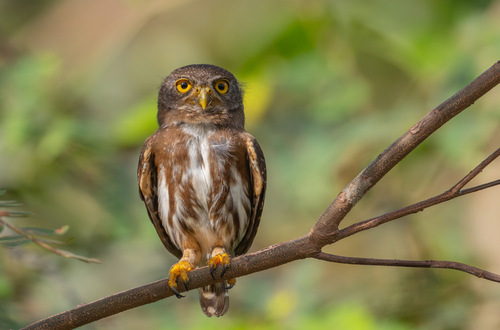
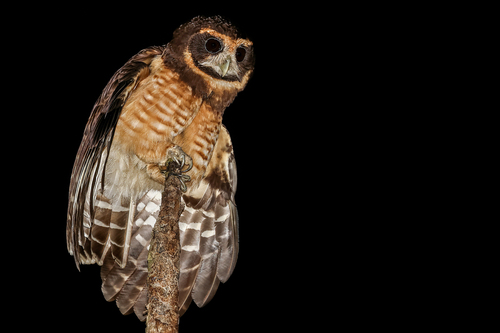
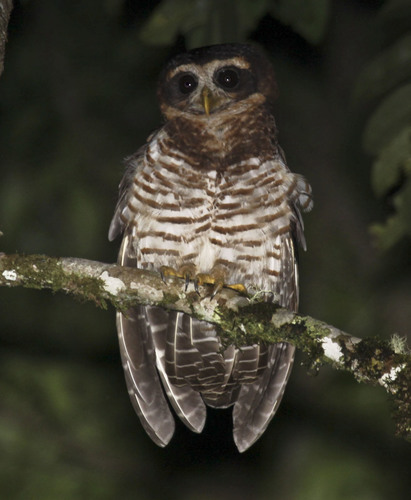
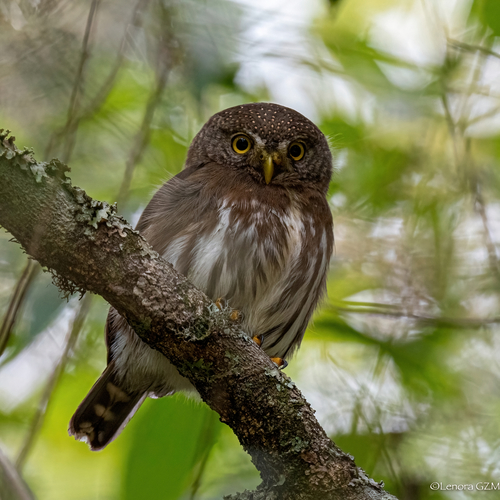
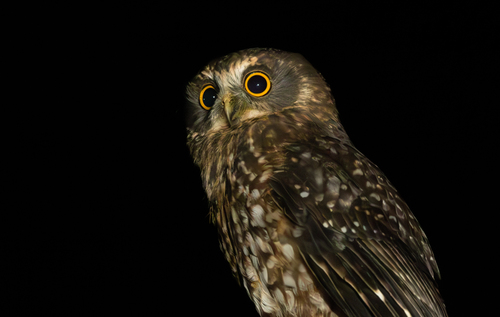
The morepork generally has dark brown coloring on its head and upperparts. It bears pale brown spots on the head and neck, and white markings on the rest of the upperparts. It has a pale yellow-white supercilium (eyebrow), dark brown ear coverts, and buff-colored cheeks. Its eyes range from yellow to golden-yellow. Chin and throat feathers are buff with dark brown shafts. Underpart feathers are mostly dark brown, marked with buff and white spots and streaks; larger markings on the belly give the underparts an overall paler appearance. The upper surface of the tail is dark brown with lighter brown bars. The cere and bill are pale blue-grey with a black cutting edge. The feet are orange or yellow with blackish claws.
Young moreporks do not grow full adult plumage until their third or fourth year. The tips of juvenile feathers are white and fluffy, and are remnants of nestling down. These worn tips persist the longest on the head, and disappear gradually over time. Overall, the feathers of the juvenile head, neck, and underparts are fluffier than those of adults, and the entire juvenile plumage is a darker, more greyish brown than adult plumage.
In terms of distribution and habitat within New Zealand, this morepork subspecies is common in the North Island from Rangaunu Harbour south to southern Taranaki and west of Tauranga, Lake Taupō, and Whanganui. It is also common in the North Island between Murupara and the Hangaroa River in the northeast, and in southern Manawatū, Wellington, and Wairarapa in the south; it is uncommon outside these North Island areas. In the South Island, it is more common west of the Southern Alps, around Marlborough, and in Southland. It is common on Stewart Island and all nearby offshore islands. In New Zealand, it primarily lives in forests dominated by Podocarpus, Nothofagus, Metrosideros, and other hardwoods, ranging from low elevations up to the alpine tree line. On Norfolk Island, it inhabits forests dominated by the Norfolk Island pine (Araucaria heterophylla).