About Niltava vivida (Swinhoe, 1864)
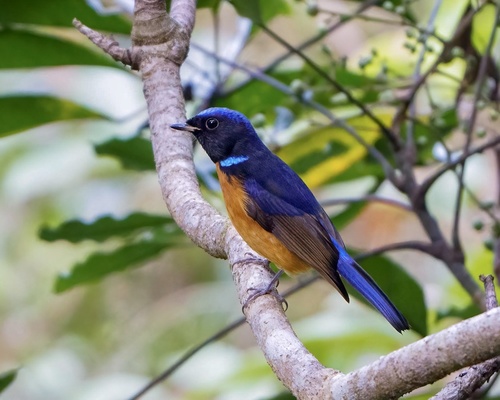
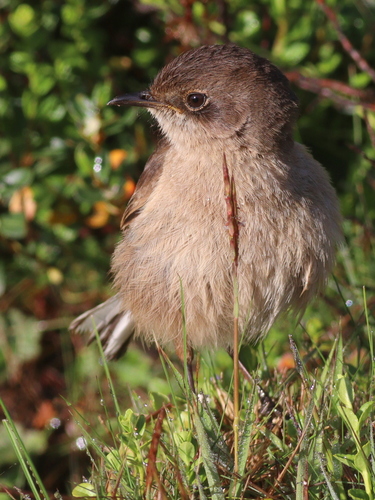
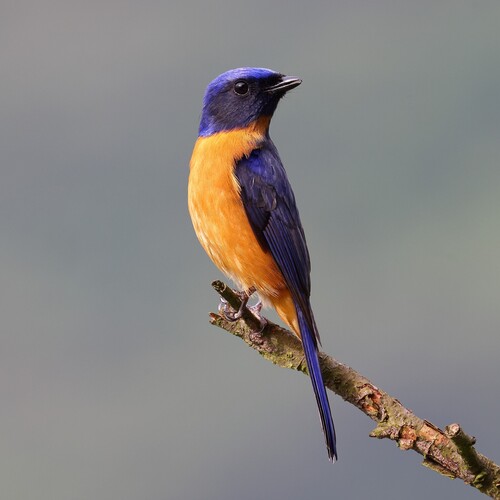
The Taiwan vivid niltava (scientific name Niltava vivida), also called the small vivid niltava, is a bird species that belongs to the Muscicapidae family. This species was first formally described by Robert Swinhoe in 1864. It is endemic to the island of Taiwan. The Chinese vivid niltava (N. oatesi), a larger species found on the Asian mainland, was formerly classified as the same species as the Taiwan vivid niltava. The natural habitat of the Taiwan vivid niltava is subtropical or tropical moist montane forests. The Taiwan vivid niltava is a medium-sized bird, measuring 16 cm long, and is a member of the Old World flycatcher family. Males have deep purplish blue plumage on the head, back, tail, and lesser wing coverts, with bright rufous orange coloring on their underparts. Their throat, face, wings, iris, legs, and bill are all black. Females are overall olive brown, with lighter coloring on the underparts, a light buffy throat, and greyish-brown crown and nape. Like many other members of its family, the small vivid niltava has distinct rictal bristles at the base of its bill.