About Nihonhimea tesselata (Keyserling, 1884)
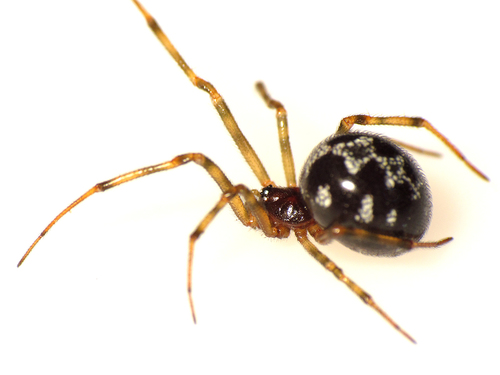
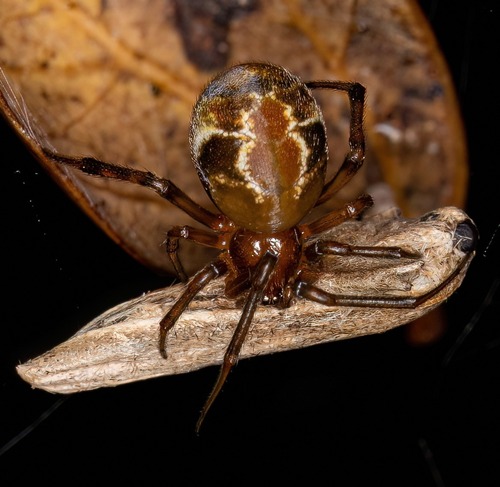
This description of Nihonhimea tesselata (Keyserling, 1884) is drawn from Keyserling's original description and Levi's subsequent redescription. Females of this species reach approximately 3.7 mm in total body length. The female cephalothorax measures roughly 1.4 mm long, 1.2 mm wide at its center, and around 0.5 mm wide across its front portion. The female opisthosoma is approximately 2.6 mm long and 2.0 mm wide. The cephalothorax is reddish-yellow, with brownish color extending far up its sides; the mouthparts are also reddish-yellow. The sternum is light yellow, with an incompletely continuous black longitudinal stripe running through its center. The legs are yellow, with brown coloring on the front and back of femora, most noticeably on the front two pairs of legs. All leg segments end in black rings. The opisthosoma has the characteristic tessellated pattern that gives the species its scientific name. It has a yellowish background, with three narrow light cross-bands that are interrupted by a broad longitudinal band on each side. Between these light cross-bands sits a yellow pattern with wavy borders, which contains a small dark brown spot at the back. Like many other theridiid spiders, this species shows sexual dimorphism, with males being smaller than females. Males of the previously synonymized species A. terex were recorded to have a total length of 1.3 mm and distinctive palpal structures. N. tesselata has a wide distribution: it occurs naturally from Mexico to Paraguay across the Americas, and has been introduced to Pakistan, New Guinea, and Queensland, Australia. N. tesselata builds aerial cobwebs, and has been recorded in a range of habitats including Eucalyptus plantations. It typically builds its webs in the distal portions of tree branches, a position that allows it to effectively capture flying insects. It is a web-building spider that constructs three-dimensional cobwebs that include both sheet and tangle portions. Very small, water-soluble viscid globules are present in both the sheet and tangle sections of these webs. The spider's prey attack behavior follows a three-step sequence: it descends from its suspended retreat, passes through the sheet threads, and wraps the prey from underneath the sheet. Attacks can complete this sequence as quickly as 0.11 seconds after the spider begins its descent.