About Nihonhimea japonica (Bösenberg & Strand, 1906)
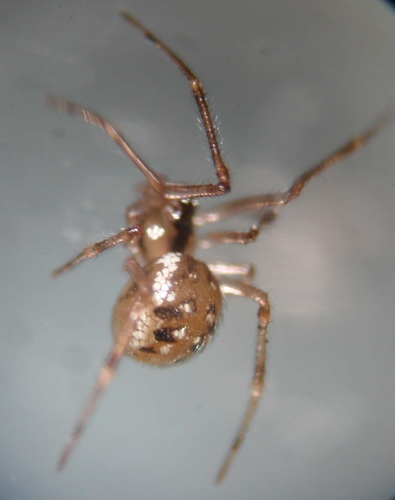
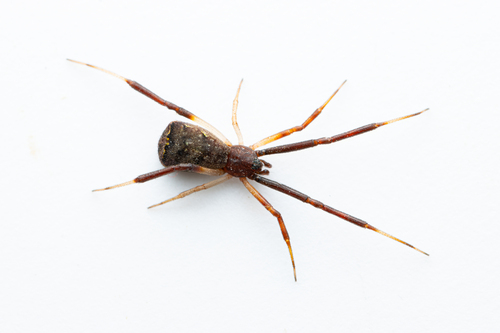
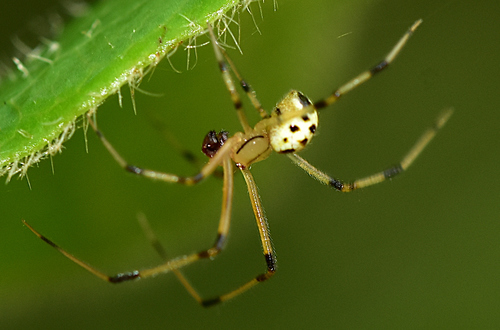
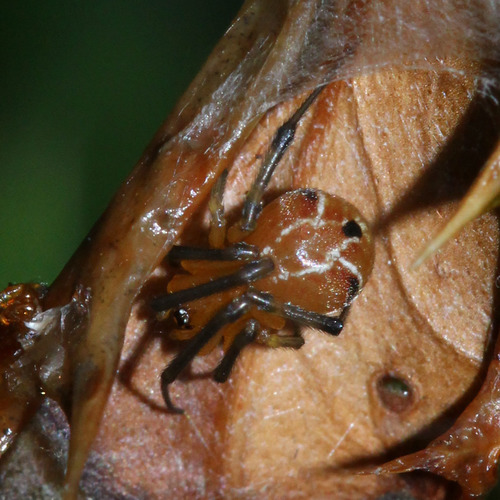
Nihonhimea japonica is a small theridiid spider that shows distinct sexual dimorphism. Females are larger than males, with a body length of 3.5–5 mm, while males reach 2.5 mm in body length. In females, the cephalothorax is light brown, with darker brown markings that extend from the head region to a central depression; two lines continue from this depression across the posterior portion of the cephalothorax. The anterior median eyes are slightly larger than all other eyes, and appear blackish; the remaining eyes are bright whitish-yellow. All eyes sit on a single shared protruding elevation. The sternum is yellow, and the chelicerae are brown. The yellow maxillae are long and narrow, and they converge slightly at their tips. The brown labium is edged and rounded with yellow, and it is noticeably wider than it is long. Female pedipalps are quite robust, with the last two segments considerably thicker than the leg tarsi. The legs are brownish-yellow, with darker coloration at the tips of segments; black markings are particularly visible on the fourth tibia and third metatarsus. The female opisthosoma is brownish-gray or yellowish-brown, with a characteristic pattern made up of three bright white, crescent-shaped arcs, each holding a single black, round spot. The lowest white arc is shorter than the lateral arcs, and extends toward the posterior end of the body in a wedge shape. In older individuals, two extra white longitudinal stripes may develop running toward the posterior, leaving an empty space at the base between the spots. The triangular anal region is solid white. The abdomen is brownish-yellow, with the central area slightly lighter than the sides, and bears a large dark brown spot at its center. Males are generally darker overall, especially in the color of the cephalothorax and legs. Their abdominal pattern differs from that of females: only the two middle spots are present, the posterior triangular spot that appears in all females is absent, and the white crescent-shaped markings are also absent. Nihonhimea japonica is widely distributed across East Asia, and has been recorded from Japan, Korea, China, Taiwan, and Laos.