About Nidorella resedifolia DC.
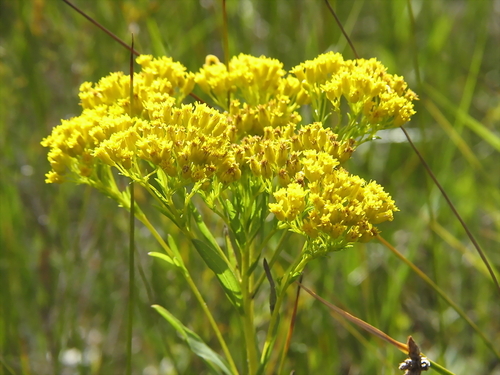
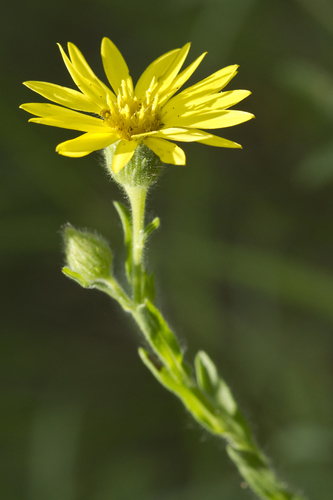
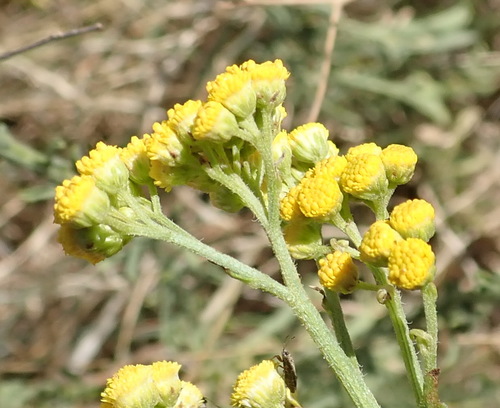
Nidorella resedifolia DC. is an erect herb that can be either annual or perennial, typically growing between 0.5 and 1.5 meters (1.6 and 4.9 feet) tall. Its stems are usually single at the base and branch toward the top, and they are often pubescent (hairy) and greenish in color. The leaves are arranged alternately, and are deeply lobed (pinnatifid); their resemblance to the foliage of plants in the genus Reseda gives this species its specific epithet resedifolia. The leaves are generally sessile (lack a stalk) and can grow up to 80 mm (3.1 in) long. This plant produces dense, flat-topped clusters called corymbs made up of small, bright yellow flower heads known as capitula. Each flower head is approximately 5 to 10 mm (0.20 to 0.39 in) in diameter. The ray florets are either very small or completely absent, which gives the flower heads a button-like appearance similar to that of Tanacetum vulgare (tansy). Its fruit is a small achene topped with a pappus of bristles, which helps the fruit disperse via wind. This species is widespread across eastern and southern Africa, occurring in Angola, Botswana, the Democratic Republic of the Congo, Eswatini, Ethiopia, Lesotho, Mozambique, Namibia, Zimbabwe, and South Africa. It is also found in Madagascar. Within South Africa, it is especially common in the northern provinces: Limpopo, Gauteng, and Mpumalanga. It prefers open, sunny environments and is often associated with the grassland and savanna biomes. It is classified as a pioneer species that readily colonizes disturbed soil, roadsides, and old cultivated lands. Nidorella resedifolia is generally unpalatable to livestock because of its strong aromatic oils, but it contains alkaloids that can be toxic if ingested in large amounts. Reports of toxicity are rare because animals usually avoid the plant unless grazing pressure is high or during drought periods. It is often confused with the more dangerous Senecio species (ragworts), which share a similar growth habit and yellow flowers.