About Nicrophorus vespillo (Linnaeus, 1758)
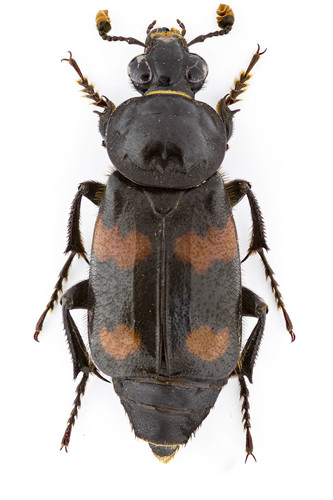
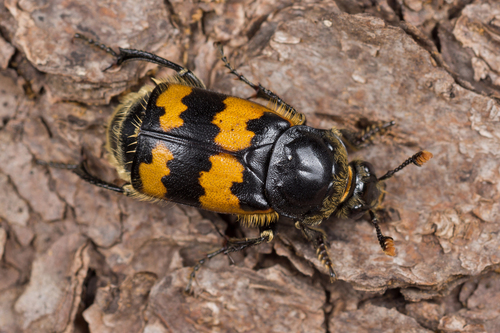
Nicrophorus vespillo are large beetles, measuring 12 to 25 mm in length, and are strong fliers. They have two distinct orange-yellow bands across their wing cases. They can be told apart from other species in the Nicrophorus genus by the long golden hairs covering their body and wing cases, their orange club-shaped antenna tips, and the shape of their hind legs. These beetles live on carrion and lay their eggs near carrion. Their breeding season runs from May to September, and both parents take part in preparing for offspring and caring for them. Parents excavate soil beneath suitable small animal corpses, then cover the corpse with soil to bury it before the female lays eggs. They may move the corpse to a more suitable location before burial. For a small animal such as a mouse, burial can be completed within one day. After burial, the parents remove hair or feathers from the corpse and shape it into a ball inside a small underground chamber. They lay eggs in the soil surrounding this chamber. Once the larvae hatch, both parents feed and protect the young. Parental care lasts for a minimum of 10 days; it can last up to 30 days earlier in the breeding season, when cooler temperatures slow the young beetles’ development. The young consume the carrion corpse directly, and also eat pre-digested food regurgitated by their parents. To finish their development, the beetles pupate in the soil before emerging as adults. Pupae that form toward the end of the breeding season may hibernate over winter, and emerge as juvenile beetles the following spring.