About Nicrophorus tomentosus (Weber, 1801)
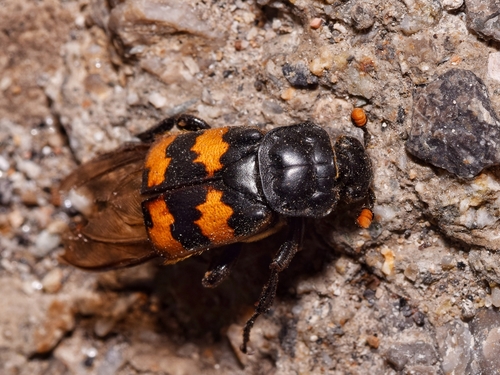
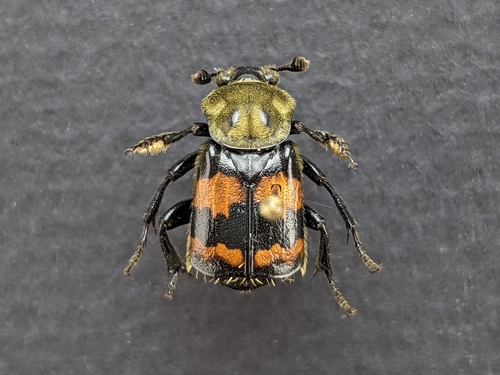
This species, Nicrophorus tomentosus, has several distinguishing physical traits. Adults measure between 11.2 and 19.0 millimeters in length. They have a pair of striations on the fifth abdominal tergum, and a very large scutellum that can sometimes be as wide as the head. All segments of their antennae are black, clubbed at the tips, and hold olfactory organs. Their flight pattern matches that of a bumble bee. Their elytral epipleuron is entirely black aside from symmetrical orange patches. A thick patch of golden yellow setae covers the pronotum, a feature that separates N. tomentosus from other species in the Nicrophorus genus.
Nicrophorus tomentosus lives in habitats that contain animal carcasses, which range from dead rodents to dead birds; common thriving habitats for these beetles include forests, woodlands, shrub land, and sandy prairies. The species has a worldwide distribution, and in the western hemisphere it occurs across most of the United States (excluding the southeast region) and southern Canada east of the Rocky Mountains. N. tomentosus is seasonal, and can only be found between May and October, with peak occurrence in July and August.
Mating between adult male and female N. tomentosus begins after they find and bury a new food source (carcass), and can occur anywhere around the carcass rather than being restricted to the carcass itself. Females deposit eggs into nearby soil at least twelve hours after the carcass is discovered. Eggs hatch after approximately four days, and newly hatched larvae move toward the carcass to reach a feeding hole created by their parents. Both parents feed larvae with regurgitated food for six to eight days, at which point larvae are fully developed. Fully developed adults then repeat the life cycle by locating a new carcass and mating. Recently, N. tomentosus was identified as one of at least two burying beetle species that can breed in the forest canopy.