About Nicrophorus pustulatus (Herschel, 1807)
This species is sometimes referenced as N. pustulatus Herschel, named for Johann Dietrich Herschel. Herschel published an article describing two Nicrophorus beetles, and Johann Karl Wilhelm Illiger added a footnote naming one of these species N. pustulatus. While the article displays 1807 on its title page, it may actually have been published in 1808, so some sources attribute the scientific name to Illiger, 1808. However, the valid name registered for this species with the Integrated Taxonomic Information System (ITIS) and the Catalogue Of Life (COL) remains Nicrophorus pustulatus Herschel, 1807. The original publication describing this species is accessible through the Biodiversity Heritage Library, with the relevant naming footnote on page 271. The presumed holotype specimen collected by Herschel was part of the Hellwig and Hoffmannsegg insect collection purchased by the Museum für Naturkunde Berlin in 1817, and it is held today as one of many historical type specimens in the museum's Beetles and Streptiptera collection.
N. pustulatus is a medium-sized beetle, with an average body length between 14.0 and 22.2 mm. Like other members of the Silphidae beetle family, it has a semi-flattened body, prominent tibial spurs, clubbed antennae, and an elytra shape that is broader at the posterior end. It can be classified as part of the Nicrophorinae subfamily by its distinctly clubbed, 10-segmented antennae, and shortened elytra that leaves 3 to 4 posterior abdominal segments exposed.
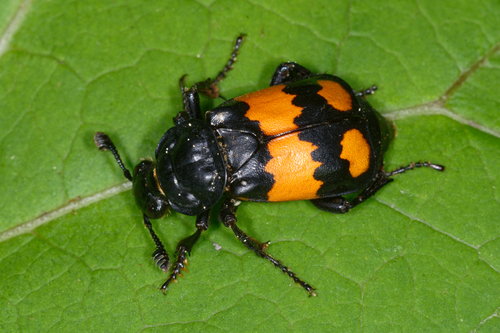
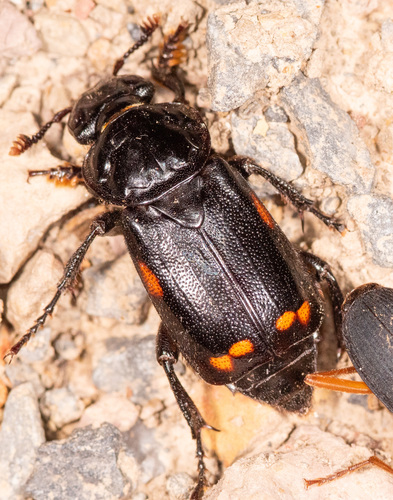
The body of N. pustulatus is shiny and mostly black, with characteristic small orange spots on its elytra. Each elytron holds one spot midway along its lateral edge, and two smaller spots at the posterior apex. These bright spots function as aposematic signals. Compared to the more circular pronotum of other Nicrophorus species, N. pustulatus has an oval-shaped pronotum. Each antenna ends in a lamellate club split into one basal black segment and three terminal orange segments. Unlike other species in the genus, N. pustulatus does not have long setae on the dorsal surface of its elytra. This species has sparse yellow to brown pubescence (hairs) on the ventral surface of the metathorax, and is glabrous on the metepimeron on the side of the metathorax. N. pustulatus also has a straight hind tibia, a lobe on the apex of the mesotibia, an entirely black epipleuron, and a long epipleural ridge on the elytron that extends forward toward the scutellum. Additional photos of this species are available via the Maryland Biodiversity Project and iNaturalist.
N. pustulatus is distributed across North America. It occurs in southern Canada east of the Rocky Mountains, spanning the provinces and territories of Alberta, Saskatchewan, Manitoba, Ontario, Quebec, New Brunswick, Nova Scotia, and Prince Edward Island. It has been found as far north as near Marten Falls in Ontario's Kenora District and Akimiski Island, Nunavut, in Hudson Bay. One unconfirmed potential observation of N. pustulatus was submitted to iNaturalist from Saint Pierre and Miquelon, off the coast of Newfoundland, Canada. The species' range extends south into the eastern United States, ranging from North Dakota south to Florida and eastern Texas. N. pustulatus is not currently known to live outside of North America. Distribution maps based on observation data are available from iNaturalist and the Global Biodiversity Information Facility (GBIF), and the Catalogue Of Life (COL) provides a full list of Canadian provinces and American states where the species has been recorded.
Across its range, N. pustulatus was formerly considered rare, with little known about its habitat requirements. Ground pitfall traps baited with carrion, which typically capture other Nicrophorus species effectively, do not work well for this species: N. pustulatus makes up only 0 to 6% of Nicrophorus specimens caught in these traps. However, more recent efforts using baited traps placed above ground in forest canopies have successfully captured this species. N. pustulatus is now believed to be a common specialist of temperate forest canopies, found in mature deciduous and mixed forests across its range, which matches older anecdotal observations that adult N. pustulatus are found primarily in forests. It has been detected in urban, suburban, and rural forests.
For many years, the reproductive strategy of N. pustulatus remained unknown, and multiple knowledge gaps still exist. Recent research and observations show that this species differs in its reproduction from other members of its genus. N. pustulatus reproduces sexually, with a variable breeding system that can include monogamy, polygyny, polyandry, or polygynandry. In Ontario, Canada, the species is reproductively active from late April through May or June.
Like all Nicrophorus beetles, N. pustulatus centers reproduction on using small vertebrate carrion or other vertebrate-derived resources to raise its broods of offspring. The typical reproductive process for the genus begins when adults emerge from overwintering in spring and search for suitable breeding resources via chemoreception. The beetles assess the suitability of any carcasses they find by tasting and manipulating them to confirm appropriate size and freshness. Nicrophorus beetles target very fresh small carcasses, such as those of mice or birds, that have not yet been used by other insects like flies. Males release pheromones to attract females. If a male has not located a carcass, the pair will mate and separate, and the female stores the sperm to use later. If a male has found a suitable carcass, the pair may mate repeatedly while preparing the carcass: they remove hair or feathers, apply anti-microbial secretions, shape the carcass into a rounded brood ball, and bury the ball underground by digging beneath it. During this process, the pair may face competition from other beetles of the same or different species, along with additional mating opportunities. Females are oviparous, and lay their clutch of eggs in soil next to the carcass. Most of this typical reproductive process applies to N. pustulatus, with a few unique exceptions: N. pustulatus has not been recorded using carrion or burying breeding resources underground in wild conditions. Studies on the related species N. vespilloides show that mated pairs raising broods together can recognize each other via the pattern of hydrocarbons on their cuticles. The size of an N. pustulatus brood and its individual larvae depends on the size of the breeding resource, population density, and the age, size, and condition of the female. Compared to other members of the genus, N. pustulatus pairs are hyper-fecund, and have been recorded raising broods of up to 187 offspring on larger carcasses in captive settings.
As canopy specialists, N. pustulatus beetles have evolved to rely on small birds and mammals in the canopy as a key source of carrion. One study conducted in the Frontenac Arch region of Ontario, Canada found that the highest abundance of adult N. pustulatus occurs during the breeding season of most small bird and mammal species, when carrion availability is highest due to offspring mortality. This suggests that the phenology of this species' life history and population dynamics has evolved to align with the phenology of other canopy species that provide carrion resources.
A key remaining knowledge gap concerns which breeding resources N. pustulatus uses in the wild. Unlike most Nicrophorus beetles that use and bury small carcasses underground, N. pustulatus appears able to use a wider range of resources in unusual ways. In the wild, N. pustulatus has only ever been observed successfully breeding on snake eggs. It has not been observed reproducing on small carcasses in the wild, whether naturally occurring or experimentally placed, though this may be because experimental carcasses are typically placed on the ground rather than in the canopy. The forest canopy holds abundant carrion resources that this species could potentially use, including carcasses of squirrels, birds, and bats. Recent studies using canopy traps baited with raw chicken and fish have successfully captured adult N. pustulatus. In laboratory settings, N. pustulatus buries small vertebrate carcasses of approximately mouse size, which matches typical genus behavior, but it also successfully uses larger rat-sized carcasses. In experiments that offered mouse carcasses, snake eggs, and turtle eggs, N. pustulatus pairs successfully raised broods on all three resources, and even combined resources by using both carrion and snake eggs at the same time. N. pustulatus has also been found in association with bird nests. In one observation at the Queen's University Biological Station outside Kingston, Ontario, Canada, a Nicrophorus pustulatus beetle was seen burying live tree swallow (Tachycineta bicolor) nestlings under the substrate of a nest box. The beetle may have first been attracted to a single dead nestling, then went on to bury the remaining live ones. In another case, three adult N. pustulatus were found in a failed northern saw-whet owl (Aegolius acadicus) nest. As a canopy specialist, N. pustulatus may use bird nests as food sources or reproductive sites, and may even target fish-eating raptor nests as sources of fish carrion. Burying carrion in the canopy is unlikely unless beetles can use existing bird nest structures. Additionally, N. pustulatus does not appear to bury snake eggs when it uses them for breeding, even though it buries small carcasses in laboratory settings. This means the characteristic burying behavior the Nicrophorus genus and Nicrophorinae subfamily are known for may not be typical of N. pustulatus.
Both adult and larval N. pustulatus are necrophagous, meaning they feed on dead organic matter. Adult N. pustulatus may eat fly larvae, the larvae of competing species, and carrion at carcasses, as well as other food sources including dung and decaying fungi. They consume carrion via extra-oral digestion: they apply oral secretions containing proteinases and other enzymes to the carrion, then consume the digested fluid that results. Before breeding season, adults feed on larger, more decomposed carcasses, in contrast to the smaller, fresher resources they use for breeding. N. pustulatus larvae feed exclusively on pre-digested carrion or other food provided by their parents.