About Nicrophorus orbicollis (Say, 1825)
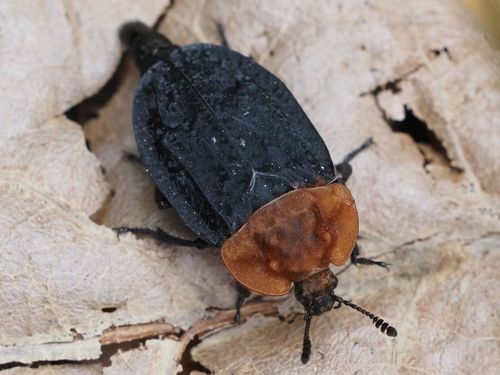
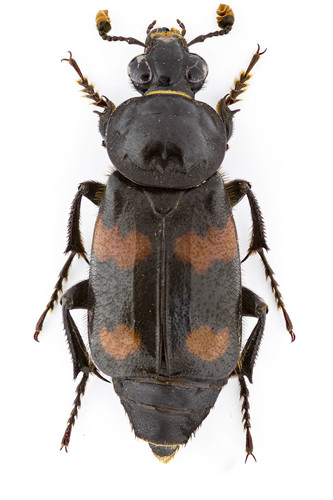
Nicrophorus orbicollis is a nearctic burying beetle first formally described by Thomas Say in 1825. It belongs to the genus Nicrophorus, commonly called sexton beetles, which are the most common beetles grouped in the family Silphidae. This species acts as a decomposer, feeding on the carcasses of small dead animals. It has applications in scientific research for both medical and forensic studies, when the beetle is present in the study area. Adult Nicrophorus orbicollis are active starting in early spring, with the first adults emerging in late May. Reproduction takes place from June through August, and newly matured teneral adults emerge from late July to early August. This species overwinters in the adult life stage, and is found primarily in open and forested habitats. Adults of this species are nocturnal. N. orbicollis is multivoltine, and adult beetles provide care for their offspring during larval development. The species ranges from southeastern Canada to the southern tip of Florida and as far west as East Texas; it has also been recorded as far west as Nebraska and as far north as North Dakota. It is the most frequently collected silphid species in the eastern United States. Adults can be collected between February and October, but are most commonly encountered during the summer months of June to August, due to their increased activity in warm weather. Most collected N. orbicollis individuals come from mesic forest habitats, where they are found on human and carnivore feces, rotten fruit, and carrion. Nicrophorus orbicollis is an endopterygote that undergoes complete metamorphosis; its full life cycle includes egg, larval, pupal, and adult stages. Both male and female beetles are attracted to carrion for feeding and reproduction. Male N. orbicollis attract females by emitting pheromones, and only release these pheromones when a carcass is present. After mating, females lay eggs 12 to 48 hours after locating a suitable carcass. Eggs hatch approximately 56 hours after being laid. Once larvae finish their development, they pupate in the soil within 6 to 8 days. The size of the carcass used affects the length of time from egg laying to larval dispersal, and also changes how long parent beetles will care for their young. In general, the period from egg burial to larval dispersal is shorter on smaller carcasses. Male N. orbicollis also spend less time caring for their offspring when developing on small carcasses. Larvae of most silphid species depend on parental feeding, but can sometimes feed directly from the carcass. However, N. orbicollis larvae are extremely dependent on their parents for feeding, and will die before reaching the second instar if they do not receive parental care. Offspring body mass has a positive correlation with the length of maternal care. N. orbicollis is nocturnal, and must compete with dipterous larvae for oviposition sites on carcasses. Nicrophorus orbicollis relies on small vertebrate carcasses to provide enough food for its developing young. Mating occurs between mid-June and early August, and the species is mostly active after sunset. Males first attract females by producing pheromones. Competition takes place between other burying beetles and other carrion-feeding competitors to secure a carcass for mating. N. orbicollis is commonly observed competing with N. defodiens. Larger beetles are more likely to outcompete smaller beetles to claim a carcass. After a carcass is secured and buried, the female lays her eggs in the soil surrounding the carcass. Larvae typically hatch 5 to 7 days later. Both female and male adults take on important roles as their larvae mature. Adults handle preserving the carcass, protecting larvae from predators, and feeding the larvae. Males disperse away from the carcass once larvae reach their final instar. Females remain at the carcass until larvae disperse into the soil to pupate, which usually occurs 17 days after the carcass is buried. Depending on the size of the carcass, parent beetles can regulate the number of their offspring through a process called filial cannibalism. Parents use this process to create more space for surviving offspring when developing on a smaller carcass. Nicrophorus orbicollis has not been found to have a direct impact on the economy. It does play a very important role in nutrient recycling. A pair of one male and one female beetle will bury a decomposing carcass, convert it into nutrients for their larvae, and feed it to their young by regurgitation. These beetles secrete an antibiotic substance that slows decomposition of the carcass, to reduce competition for the resource and ensure their young have enough food. Little is currently known about the medical importance of N. orbicollis. Its ability to recycle dead, decomposing organic matter plays an indirect role in supporting the health of ecosystems where it lives. The natural antibiotics secreted by this species may have potential future medical benefits, but nothing is currently known about how the beetle secretes this substance.