About Nicrophorus hebes (Kirby, 1837)
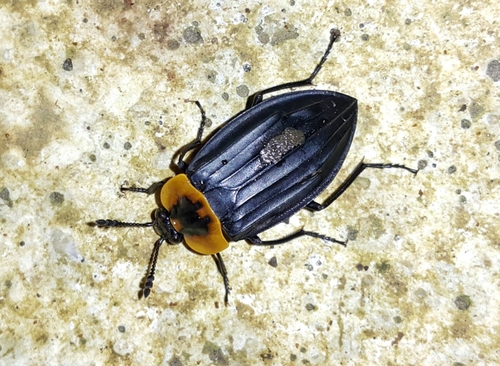
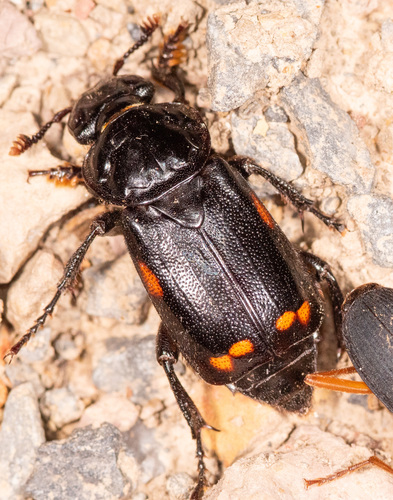
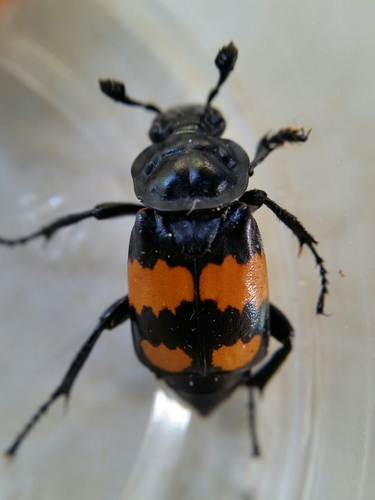
Nicrophorus vespilloides beetles have highly variable body size, ranging from 12 to 20 mm. They have two distinct orange-yellow bands on their elytra, and their antennae are completely black. Their orange and black markings act as a warning to avian predators, protecting them from attacks. Their distinct wing cases are squarish and shorter than their abdomens, and they are capable of flight, which they use especially to locate carcasses.
This species has a wide geographic distribution, covering far northern Scandinavia in Europe, Siberia, multiple parts of Asia including China and Japan, and extending into North America where it occurs in northern United States and most of southern Canada. It is found across both the Palaearctic and Nearctic biogeographic realms. In the Palaearctic region, the beetles occupy a broad ecological niche, living in environments from low-lying plains to higher alpine elevations, and can be found in habitats including dense woodlands, open heathlands, parklands, and residential gardens. In the Nearctic region, by contrast, the species has more selective habitat preferences, and is primarily found in sphagnum bogs, marshy areas, and the edges of upland regions. This broad distribution and varied habitat use demonstrate the species' broad adaptability and ecological resilience.
The reproductive success of Nicrophorus vespilloides, a burying beetle, is closely tied to its reliance on finding a small vertebrate carcass to breed. When a suitable carcass is found, this triggers a large increase in juvenile hormone (JH) levels in the beetles. In other species, higher JH levels are linked to immune system suppression, which suggests there may be an immune response trade-off for burying beetles, where immune function is downregulated during the critical breeding period; this adaptation reflects the species' prioritization of reproduction even at the potential cost of reduced immune defenses.
After locating a suitable carcass, the two parent beetles work together to bury it underground. They carefully prepare the carcass by removing all fur or feathers, shaping it into a compact ball, and coating it with a mix of antimicrobials and their own secretions to slow decomposition. The beetles lay their eggs in the soil near this prepared carcass. A few days after eggs are laid, larvae hatch and move directly to the carcass, which acts as both their food source and nursery. Adult beetles provide for their young by giving them pre-digested food, and protect them from predators and competitors. If one parent abandons the brood or reduces its care, the remaining parent compensates by increasing its caregiving effort through biparental adjustment. Cases where both parents desert their offspring are extremely rare in this species, demonstrating the high level of parental investment common to burying beetles. Parental decision-making involves complex negotiation and cooperation between males and females, rather than unilateral independent decisions, with continuous interaction and mutual adjustment that indicates a sophisticated level of social coordination and communication.
The connection between parental care and offspring health and growth is strong and well-documented. Research shows that the quality of food provided by parents, particularly the freshness of the carcass, strongly influences offspring health and development: one study found that offspring had better growth and health when parents bred on higher-quality, less decomposed carcasses, compared to when parents used lower-quality, more decomposed food sources. This confirms the critical role of both parental effort and resource quality in the successful development of burying beetle young. The complex balance of resource acquisition, parental care, and offspring development highlights the intricate nature of this species' reproductive and social behavior, and provides useful insight into the evolutionary pressures and adaptations that shape its life history strategies.