About Nicrophorus americanus A.G.Olivier, 1790
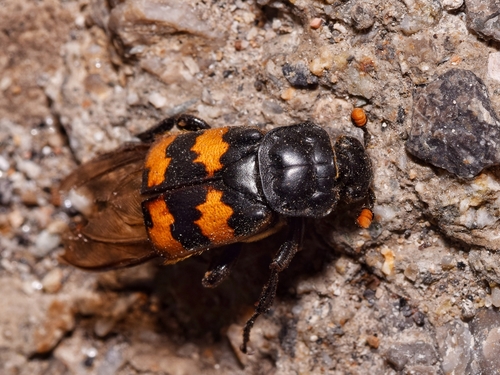
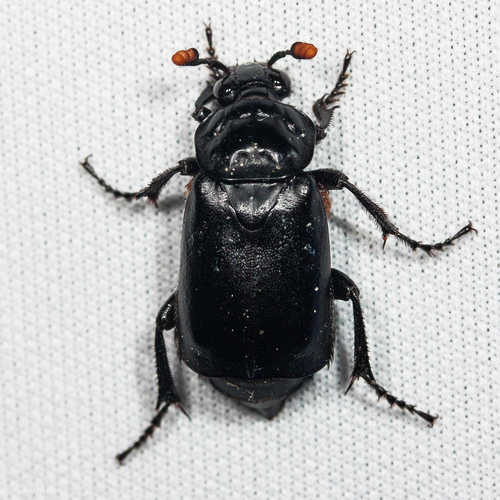
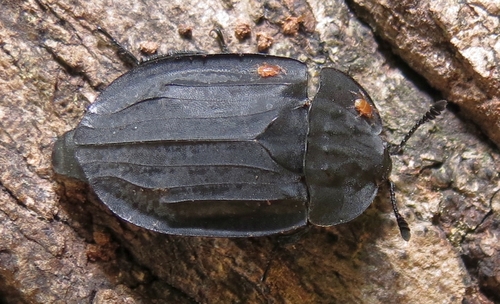
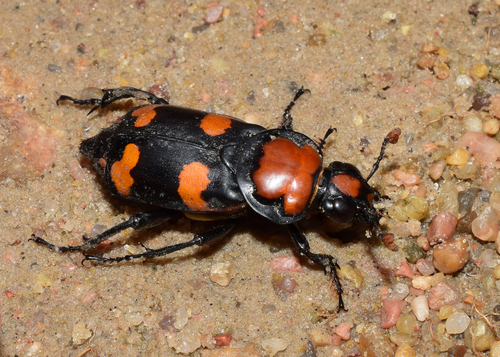
Adults of Nicrophorus americanus measure between 25 and 45 millimetres (0.98 and 1.77 inches) in length, and can be identified by their striking, distinctive coloration. Their body is shiny black, with two scalloped orange-red markings on each elytron (wing cover). Most distinctively, an orange-red marking is present on the pronotum, which separates this species from all other North American Nicrophorus. The front of the head has two orange markings: one on the frons, and a smaller one on the clypeus, the hard sclerite just above the mouthparts. The orange clypeal marking is smaller and more triangular in females than in males. The labrum has dense orange setae along its distal edge, and the antennal club is mostly orange. Adult Nicrophorus americanus are nocturnal, strong fliers, and can travel up to one kilometer in a single night.
Historical distribution records show this beetle was once found across 35 U.S. states, the District of Columbia, and the Canadian provinces of Ontario and Quebec. Currently, natural wild populations are only confirmed in ten U.S. states: Oklahoma, Arkansas, Texas, Kansas, South Dakota, Nebraska, and Rhode Island (specifically Block Island); populations have also been reintroduced to Ohio, Massachusetts, and Missouri.
During winter, when temperatures drop below 15 °C (60 °F), adult N. americanus bury themselves in soil to overwinter. They emerge from soil once temperatures rise above 15 °C (60 °F) to begin mating and reproduction. As a species of burying beetle, N. americanus has unusual reproductive behavior: both male and female parents participate in raising their young. Males typically locate carcasses first to attract a mate, and beetles commonly fight over carcasses, with the largest male and female almost always winning. The winning pair buries the carcass, mates, and the female lays her eggs in an adjacent tunnel. Larvae develop within a few days, and both parents feed and care for the young – an uncommon behavior among insects that is also seen in earwigs. Brood size typically ranges from 1 to 30 young, with an average brood of 12 to 15 individuals. Larvae feed on the carcass for approximately one week, then crawl into soil to pupate and complete development. Mature adult N. americanus emerge from the soil 45 to 60 days after their parents first buried the carcass. Adult American burying beetles have a total lifespan of only 12 months.
Historical records do not provide clear insight into the historical habitat preferences of this species. Current data indicates N. americanus is a habitat generalist that can live in many habitat types, with a slight preference for grasslands and open understory oak-hickory forests. However, this species is a carrion feeding specialist that requires carrion roughly the size of a dove or chipmunk to reproduce. Carrion availability is likely the most important factor limiting where the species can survive.