About Nicotiana quadrivalvis Pursh
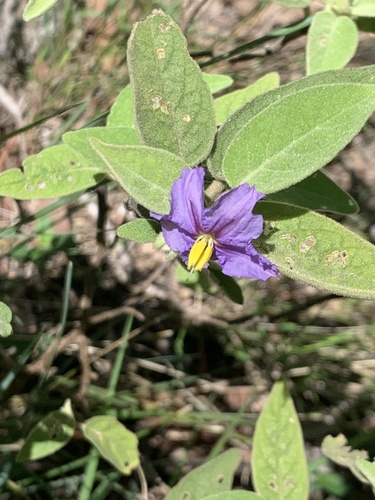
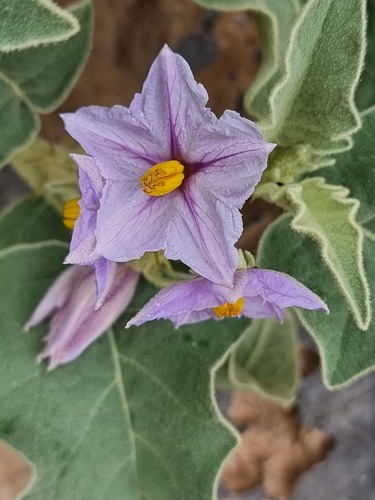
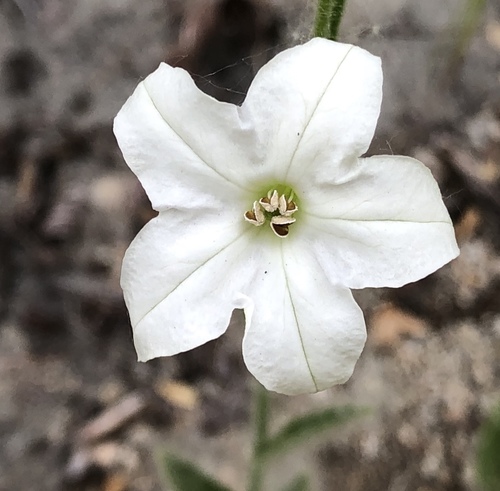
Nicotiana quadrivalvis is a species of wild tobacco commonly called Indian tobacco. Its variety N. quadrivalvis var. multivalvis is known by the common name Columbian tobacco. This species is endemic to the western United States, where it grows in many types of habitat. It is a bushy, sprawling annual herb that reaches a maximum height of two meters. Its lower leaf blades are up to 15 centimetres (6 in) long and grow on short petioles, while upper leaves are smaller and sessile on the stem. Its inflorescence is an array of several flowers, which can be white, greenish, or purple-tinged, with tubular throats up to 5 centimeters long. The base of each flower is enclosed in a ridged calyx of sepals. The open flower face may be 5 centimetres (2 in) wide. Its fruit is a capsule up to 2 centimetres (3⁄4 in) in length. Different Native American cultures also call this species 'sacred tobacco'; Nicotiana rustica may also be considered sacred.
Nicotiana quadrivalvis has traditionally been cultivated by indigenous peoples living on the west coast of the United States, primarily in southern Oregon, northern California, and along the middle Columbia River. Individually owned plots of tobacco were seeded using the previous year's seed capsules, tilled, and weeded. After harvest, plots were fertilized in the fall by mixing in rotten wood. This species was first described from the upper Missouri River, where it was cultivated by the Mandan and Arikara peoples. Further north, the Haida, Tlingit, and probably Tsimshian cultivate a related variety of tobacco, Nicotiana quadrivalvis var. multivalvis, which was long thought to be extinct, using a similar method. The original seeds for this northern cultivation must have been acquired from distant areas, as tobacco was not native to the northern Northwest Coast. Myths about this origin describe the supernatural original acquisition of the seeds. In 1825, botanist David Douglas stole seeds of var. multivalvis at night and brought them to London. The seeds were eventually held in a seed bank in Puławy, Poland, from which they were returned to the Confederated Tribes of Coos, Lower Umpqua and Siuslaw Indians.