About Nicotiana glauca Graham
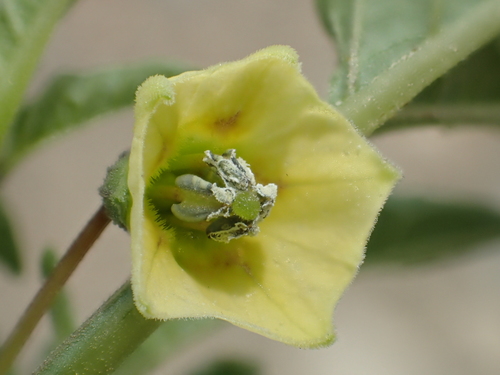
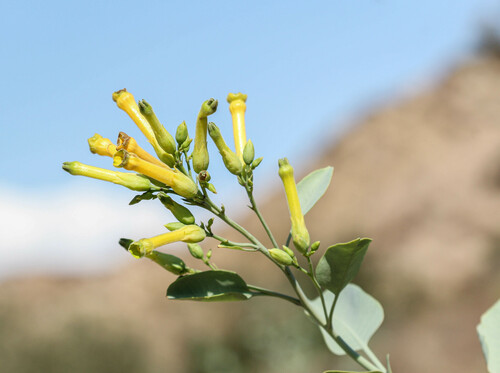
Nicotiana glauca Graham is a multi-branched small tree or shrub. It typically grows to over 2 meters tall, and can reach a maximum height of 7 meters. It has thick, rubbery leaves that can grow up to 20 centimeters long. The plant produces yellow tubular flowers that are roughly 5 centimeters long and 1 centimeter wide. It primarily reproduces via seeds. This species is originally native to South America, where it occurs in Colombia, Argentina, Chile, Paraguay, Uruguay, Brazil, Venezuela, Bolivia, Peru, and Ecuador. It has since become naturalized across much of the globe, and can be found in Australia, warmer regions of Europe, temperate Asia, the Canarian Archipelago, New Zealand, the United States, Mexico, Hawaii, and Sub-Saharan Africa, including Kenya, Tanzania (where it is invasive) and Uganda. It grows in a wide range of open and disturbed habitats, such as lakeshores and roadsides, and is most problematic in relatively dry areas. Ecologically, Nicotiana glauca threatens native species by outcompeting them for resources, and is classified as an invasive species in many regions worldwide. The beetle Malabris aculeata has been successfully used as a biological control agent in some management programmes for this species. All parts of Nicotiana glauca are potentially poisonous to humans and livestock. Native American groups use this plant for a variety of medicinal purposes. The Cahuilla people used its leaves interchangeably with leaves of other tobacco species for religious rituals, and also applied it as a poultice to treat swellings, bruises, cuts, wounds, boils, sores, inflamed throat, and swollen glands. Nicotiana glauca contains high levels of the alkaloids anabasine and nicotine, and ingesting its leaves can be fatal. The species is currently under investigation for potential use as a biofuel.