About Nicotiana attenuata Torr. ex S.Watson
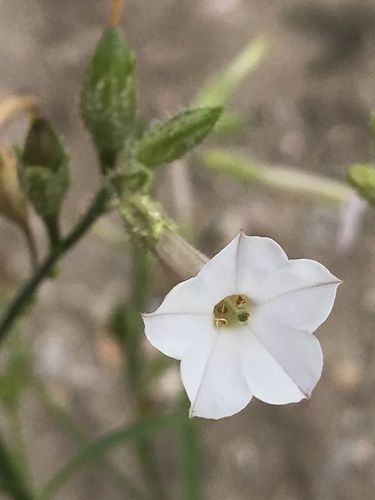
Nicotiana attenuata, a species of wild tobacco, is commonly known as coyote tobacco. This plant is native to western North America, ranging from British Columbia to Texas and northern Mexico, and grows in many different habitat types. It is an annual herb that is glandular, sparsely hairy, and can reach a maximum height of over one meter. Its leaf blades may grow up to 10 centimetres (4 inches) long; lower leaves are oval in shape, while upper leaves are narrower, and all leaves are borne on petioles. The inflorescence holds several flowers. Each flower has a pinkish or greenish white tubular throat that is 2 to 3 centimetres (4⁄5 to 1+1⁄5 inches) long, with its base enclosed in pointed sepals. The open face of the flower has five mostly white lobes. The fruit is a capsule approximately 1 centimetre (1⁄2 inch) long. Many Native American groups used this plant for a wide range of medicinal purposes, and several groups including the Hopi, Apache, Navajo, and Paiute smoked it ceremonially. Among the Zuni people, smoke from this plant is blown over the body to reduce throbbing from rattlesnake bites, and the Zuni also smoke it ceremonially.