About Neyraudia reynaudiana (Kunth) Keng ex Hitchc.
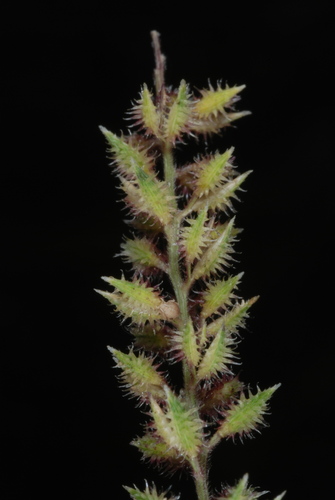
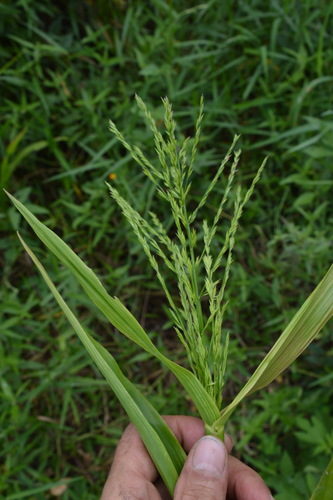
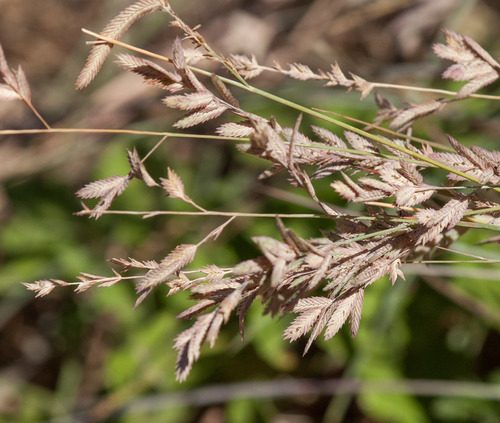
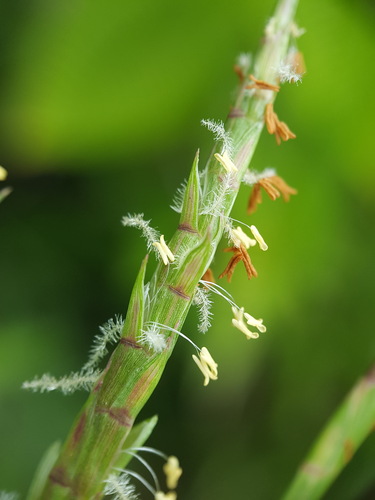
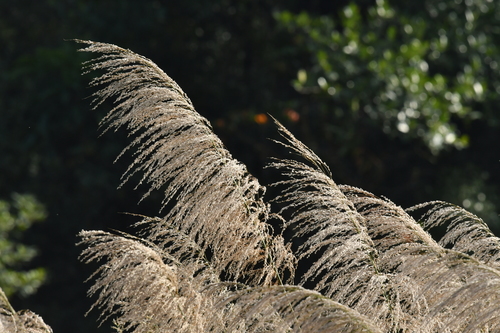
Neyraudia reynaudiana, commonly called Burma reed, has stems with flower stalks that reach 3 to 15 feet (0.91 to 4.57 m) tall, with height varying based on soil and moisture conditions. Its leaves are 8 to 10 inches (20 to 25 cm) long and hairless, except for a single horizontal line of hairs at the junction between the upper and lower portions of the leaf. Stems are roughly 0.5 inches (1.3 cm) wide, round, solid, and bear nodes (the junctures where leaves attach to stems) every 3 to 5 inches (7.6 to 12.7 cm) along their length. The plant's flower plumes can grow up to 3 feet (0.91 m) long, are made up of hundreds of tiny individual flowers, and have a shimmery, silky texture. In south Florida, Burma reed flowers in April and October; an average clump produces 40 stalks and 12 to 20 flowering plumes. This species resembles several other tall grasses: common reed (Phragmites communis), giant reed (Arundo donax), pampas grass (Cortaderia selloana), and sugar cane (Saccharum officinarum). In its native range, Burma reed is widely distributed across warm, subtropical habitats in Southeast Asia and Indomalaya, including parts of Japan, southern China, Vietnam, Laos, Cambodia, Thailand, Malaya, Myanmar (Burma), Bhutan, Nepal, and eastern India. It grows in bogs, open savannahs, upland cliffs, along forest edges, and along road edges, ranging from sea level up to 6,500 feet (2,000 m) in elevation. Neyraudia reynaudiana was first introduced into the United States on 11 January 1915 south of Miami by the U.S. Department of Agriculture, under Plant Introduction # 39690 mislabeled as N. madagascariensis and donated by Mr. C.C. Calder of the Royal Botanic Garden. A second introduction followed on 17 April 1916, under Plant Introduction # 42529 also mislabeled as N. madagascariensis, presented by Maj. A.T. Gage, Superintendent of the Royal Botanic Garden. A cryptic label annotation notes that this 1916 introduction is the source of sheet 899975 at the U.S. National Herbarium, which has the Smithsonian National Museum of Natural History herbarium code US; this sheet is dated November 1916 and was collected in Chico, California. Both 1915 and 1916 introductions originated from Sidpur near Calcutta, India. U.S. National Herbarium sheet 1385256 is a collection of this species made by Paul Weatherwax on 18 April 1927 along Bay Shore Drive southeast of Miami. An attached letter explains Weatherwax saw the species at Chapman Field in 1925, and that Mr. Bissett showed him multiple Burma reed plants at the bamboo farm near Savannah, another USDA facility in Georgia. U.S. National Herbarium sheet 1259803 is Weatherwax's 2 November 1925 collection from Chapman Field, inscribed "Not in cultivation". Another herbarium sheet has an attached 23 January 1926 letter from prominent horticulturalist Liberty Hyde Bailey to prominent agrostologist Albert Spears Hitchcock. In the letter, Bailey explains he brought the plant into cultivation at Chapman Field, and speculates it escaped into the wild in Coconut Grove, where he found it growing near residences, after garden waste containing the plant was dumped. Another collection at the herbarium, sheet 899980, was collected by N.M. Bolander in San Francisco, California in 1861, with the inscription: "Collected in front of a Chinese workhouse". While Burma reed has been documented growing in past cultivation in Florida's Highlands and Alachua Counties, as well as in Georgia and California as noted above, those original cultivated populations did not persist. Today in the United States, the species is found throughout southern Florida in Miami-Dade, Broward, Palm Beach, Lee, Collier, Monroe and Hendry counties. It first colonizes the margins of roadways, fields, and forests, and can spread from these edge habitats into undisturbed areas. Burma reed's ability to survive at high altitudes in its native range indicates it has cold tolerance, and may have the potential to spread further north in the United States. The plant's seeds and rhizomes are also accidentally transported in limestone rock quarried from infested sites; this rock is moved by train from Miami-Dade County to concrete manufacturers across the southeastern United States. This unintentional movement of Burma reed plant material may allow the species to invade new sites in Florida and adjacent states near limestone distribution centers. All reports of the related species Neyraudia arundinacea from California and Florida come from misidentified specimens of Neyraudia reynaudiana, and there are no credible confirmed records of N. arundinacea growing in the United States.