About Nettapus pulchellus Gould, 1842
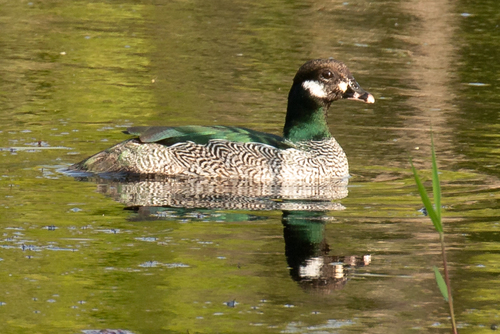
The green pygmy goose (Nettapus pulchellus Gould, 1842) measures 30 to 36 cm (12 to 14 in) in total length, making it one of the smallest duck species. Its wingspan ranges from 48 to 60 cm (19 to 23.5 in). This species has a small bill and a compact body shape. Breeding males have a mostly dark green back and neck, a dark gray crown, white cheeks, and pale gray underparts marked with white scalloping. Their tail, primary flight feathers, and primary coverts are black, while their secondary flight feathers are white, and their secondary coverts are dark and iridescent green. Outside of the breeding season, this iridescent coloration is lost, and the male’s plumage becomes duller. This species shows sexual dimorphism: the female has a barred neck instead of a green neck, but is otherwise similar in appearance to a non-breeding male. Immature green pygmy geese have less bright plumage overall, and mottled dark brown heads. Males produce a high-pitched whistle, while females give a lower-pitched call. The green pygmy goose is distributed across southern New Guinea and northern Australia, spanning from Western Australia through the Northern Territory into Queensland. To the west, it is a common visitor to Timor-Leste, where it may possibly breed at Lake Iralalara. The species is largely non-migratory and resident, only moving to disperse during the wet season. It inhabits well-vegetated lowland lagoons and other permanent freshwater bodies.