About Netta rufina (Pallas, 1773)
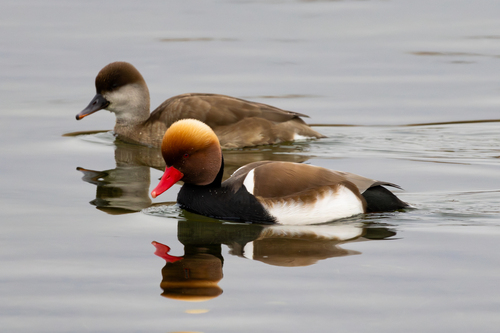
The red-crested pochard, with the scientific name Netta rufina (Pallas, 1773), is a large species of diving duck. Its scientific name comes from Greek Netta, meaning "duck", and Latin rufina, meaning "golden-red", which itself comes from Latin rufus, meaning "ruddy". This species breeds in lowland marshes and lakes in southern Europe, with its breeding range extending from steppe and semi-desert areas around the Black Sea through to Central Asia and Mongolia. It winters in the Indian subcontinent and Africa, and is somewhat migratory; birds breeding further north travel farther south to winter in northern Africa. Adult male red-crested pochards are easily identifiable: they have a rounded orange head, red bill, black breast, white flanks, brown back, and black tail. Females are mainly pale brown, with a darker back and crown, and a whitish face. Males in eclipse plumage look similar to females, but retain their red bills. Red-crested pochards are gregarious, forming large flocks during winter that often mix with flocks of other diving ducks including common pochards. They feed mainly by diving or dabbling, eating aquatic plants, and typically upend to reach food more often than most other diving duck species. Males produce a wheezing veht call, while females can be heard giving a series of hoarse vrah-vrah-vrah calls. These birds build their nests beside lakes among vegetation, and lay between 8 and 12 pale green eggs. The status of the red-crested pochard in the British Isles is highly unclear: many individuals have escaped captivity or been deliberately released over the years, alongside natural visits from continental European populations. Most red-crested pochards present in the British Isles today originate from accidental escapes and deliberate introductions. The species is most numerous across parts of England including Gloucestershire, Oxfordshire, and Northamptonshire, and has also been recorded in Leicestershire. The red-crested pochard is one of the species covered by the Agreement on the Conservation of African-Eurasian Migratory Waterbirds (AEWA).