About Netta peposaca (Vieillot, 1816)
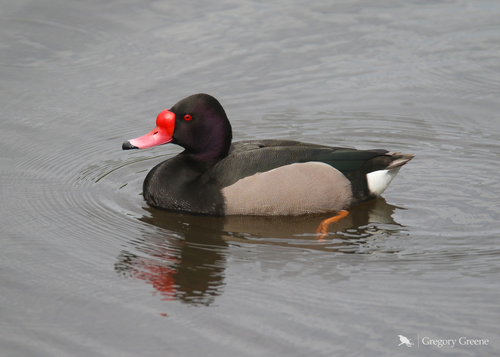
Like many other members of the duck family Anatidae, the rosy-billed pochard (Netta peposaca) shows significant sexual dimorphism. Males have a purplish-black head, neck, and breast, with gray sides, a white patch on the crissum (the area around the cloaca), bright red eyes, and a bright red bill. The bill has a large, bright red rounded knob; the rest of the bill fades gradually to pale pink, ending in a black tip. The bill's rounded knob grows larger and becomes more intensely colored during the mating season. When in flight, the bird's mostly dark plumage contrasts noticeably with its white primary and secondary flight feathers. Legs and feet are yellow to orange in males. Females, by contrast, are dull brown overall. Females have a bluish-gray bill with a black tip, and their legs range from yellow-orange to gray. Their most noticeable feature is a contrasting white crissum, just like males. Young rosy-billed pochards look almost identical to adult females, but have darker underparts. Adult rosy-bills do not develop the dull eclipse plumage that is characteristic of northern members of the genera Aytha and Anas. Males are slightly larger than females on average, but overall body size is very similar between the sexes. Adult rosy-billed pochards grow to around 22 inches (56 cm) in length, weigh between 2.2 and 2.6 pounds (1 to 1.2 kg), and have a wingspan ranging from 72 cm to 84 cm. Though they are strong fliers, their blunt-tipped wings require faster wing beats than most duck species, and they have some difficulty taking off. They do not walk as well on land as other dabbling ducks, because their legs are positioned further back on their bodies to help propel them when underwater. Rosy-billed pochards nest in tall grasses in wetlands. Their nesting range extends from the central Argentine provinces of Córdoba, Santa Fe, Entre Ríos, and Buenos Aires south to Río Negro. They also occupy shallow freshwater swamps, marshes, and small lakes. The species is fully migratory, with movements strongly tied to local water conditions. Seasonal dry periods in central Argentina force the birds to move to larger bodies of water in late summer. By early fall, these larger areas often dry out, forcing the birds to move again to find water and better food sources elsewhere. Population sizes increase during wet periods. Each breeding season, a male and female rosy-billed pochard form a seasonal pair bond; pairs are not lifelong and the species is not monogamous. There is a distinct spring courtship period where courtship displays are important. Displays are performed by both sexes before breeding, and consist of distinct movements including exaggerated drinking motions, mock preening, head bobbing, and neck extensions. Breeding generally takes place from October to November, and can occur between single pairs or within small breeding groups. Females build nests from plant material, and line the nest with down. Nests are usually built over water at the water's edge, but females have also been observed nesting in rice fields. Females lay up to 10 cream to greenish eggs, and may lay their eggs in another bird's nest if the opportunity arises. Eggs are incubated for 27 to 29 days, and young fledge between 50 and 75 days after hatching. Females raise ducklings on their own, with no help from males. Occasionally, broods from different females will merge, and females will collectively raise all the young. Humans commonly use rosy-billed pochards for consumption, as pets or display animals, and even in horticulture. The species is considered a pest in rice fields, and faces heavy hunting pressure in Argentina. Beyond direct hunting mortality, the species is also threatened by lead poisoning, because lead shot is the only available ammunition in Argentina, and research into lead toxicosis in these birds is still very recent. A 2013 study that examined lead pellet ingestion and tissue lead levels in ducks from Argentine hunting areas found that rosy-billed pochards are more likely to ingest lead shot than any other duck species in the study. Rosy-bills swallow lead bullets, mistaking them for the grit stones they need to mechanically break down food in their gizzard. Lead bullets were found in the gizzard, and elevated lead concentrations were also detected in the birds' bones, which is highly toxic and damaging to their health. Researchers believe this lead poisoning threat, combined with excessive hunting, may be causing population decline. It is relatively easy to own rosy-billed pochards, and they can even be purchased online.