About Nesospingus speculiferus (Lawrence, 1875)
Species Naming
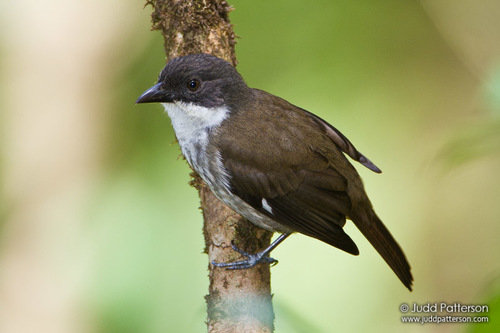
Identification: The Puerto Rican tanager (Nesospingus speculiferus) is a small passerine bird.
Size Measurements
It generally measures 18 to 20 cm (7 to 8 inches) in length, and weighs approximately 36 g (1.3 oz).
Adult Plumage (Upperparts & Underparts)
Both male and female individuals are olive-brown on their upperparts, and have pale grey to white underparts. Most adults have faint dusky striping on the breast and solid pure white throats.
Adult Head & Wing Markings
Adults also have a noticeable white spot on the wing, plus a dark crown and face that hides the eye from view. Their undertail coverts are pale fulvous.
Adult Bill Dimorphism
Males have a brown-black upper mandible and a white lower mandible, while females have entirely black bills.
Immature Plumage
Immature birds look similar to adults, but are brownish on their underparts and do not have the characteristic white wing spot.
Geographic Range Elevation
Distribution and habitat: This species is only found in mid- to high-elevation montane forests of Puerto Rico, occurring at elevations between 300 and 1,350 m (1,000 to 4,400 ft).
Preferred Habitat Types
It most often lives in mature and second-growth montane subtropical rain and wet forests, as well as subtropical lower montane forests.
Population Concentration Sites
Most of the species' population is concentrated on the eastern and western sides of Puerto Rico's central cordillera, with established populations in El Yunque National Forest and Maricao State Forest.
Habitat Fragmentation History
Historical deforestation has caused the species' population to become fragmented; it once ranged across the entire central cordillera, but is now restricted to protected areas and higher mountain peaks.


