About Nervilia concolor (Blume) Schltr.
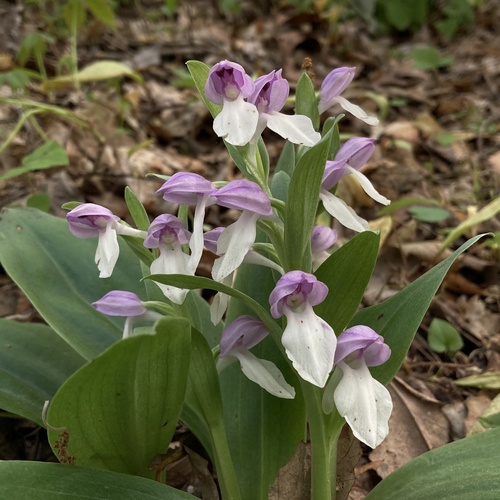
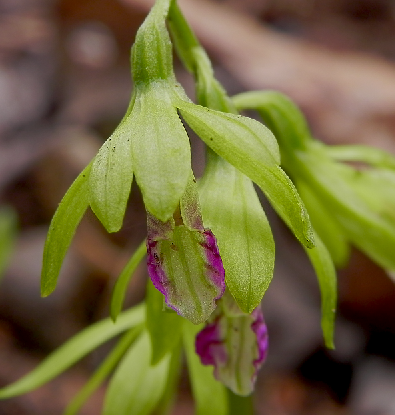
Nervilia concolor (Blume) Schltr. is a terrestrial, perennial, deciduous, sympodial herb that grows in colonies, with only a few individuals producing flowers in any given year. An erect flowering stem that reaches 200–350 mm (8–10 in) tall bears between two and six pale green flowers. Each flower measures 35–40 mm (1–2 in) long and 30–35 mm (1.2–1.4 in) wide. The sepals are 17–24 mm (0.7–0.9 in) long and about 2 mm (0.08 in) wide, while the petals are similar in shape but slightly shorter. The labellum is three-lobed, cream-coloured or yellowish, with hairy purple or green veins. Its side lobes curl inwards, and the middle lobe has wavy edges and three hairy ridges. Flowers last no more than four days; after they fade, a single leaf develops, even on plants that did not produce flowers. The leaf is bright green, heart-shaped or kidney-shaped with an almost circular appearance, 150–250 mm (6–10 in) in diameter, with wavy edges and prominent radiating veins. In Australia, this species flowers between September and December after heavy rain, while in areas north of the equator, flowering takes place in April and May. Nervilia concolor is distributed across Nepal, Bhutan, eastern India, Myanmar, Indochina, southern China, Taiwan, southern Japan, Thailand, the Malaysian region, the Pacific Islands, Queensland and the Northern Territory. It grows in forest, rainforest and monsoonal rainforest habitats.