About Nerodia taxispilota (Holbrook, 1838)
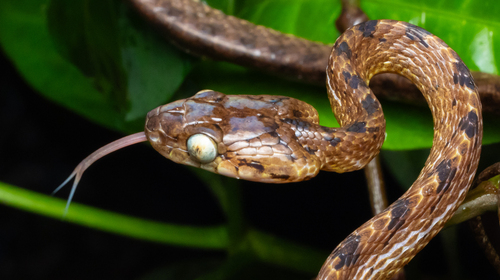
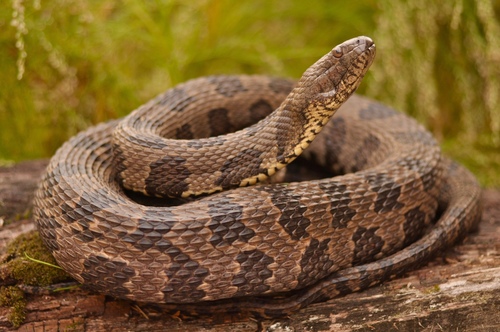
Nerodia taxispilota, commonly called the brown water snake, is a very heavy-bodied species, with a neck that is distinctly narrower than its head. Dorsally, the snake is brown or rusty brown, with a row of approximately 25 black or dark brown square blotches running down its back. Smaller blotches of the same pattern alternate along its sides. Ventrally, its base color is yellow, heavily marked with black or dark brown. Its dorsal scales are arranged in 27–33 rows, which is a higher count than any other North American water snake, and it has two to four anterior temporals, a trait where other North American water snakes usually have only one. Adult brown water snakes measure 30 to 60 inches (76 to 152 cm) in total length, with a recorded maximum length of 69 inches (175 cm). This species is found in lower coastal regions ranging from southeastern Virginia, through North Carolina, South Carolina, and Georgia, to northern and western Florida's Gulf Coast, then west through Alabama and Mississippi to Louisiana. It typically occurs at elevations from sea level up to 500 feet (150 m), and is widely distributed across the coastal and piedmont regions of the Southeastern United States. It inhabits swamps and streams, and is often mistaken for a moccasin. It is most commonly found in flowing water bodies such as rivers, canals, and black water cypress creeks, but can also occur in large water reservoirs and lakes. Because it follows a strictly fish-eating pescatarian diet, it does not live in ephemeral wetlands. Nerodia taxispilota is ovoviviparous. Mating occurs in the spring, taking place either on land or on tree branches. On average, adult females are larger than adult males. The young are born alive, usually in August, in broods ranging from 14 to 58 individuals, with broods of 30 to 40 being most common. Newborns are 7 to 10¾ inches (18 to 27 cm) long. Unlike in adult brown water snakes, male newborns are longer than female newborns.