About Nerodia sipedon (Linnaeus, 1758)
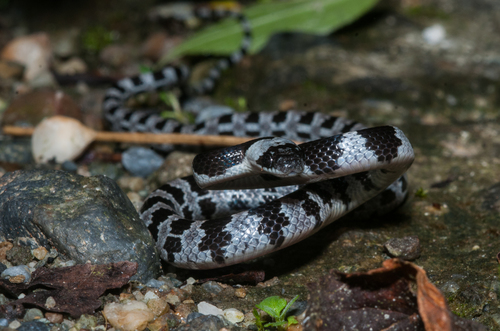
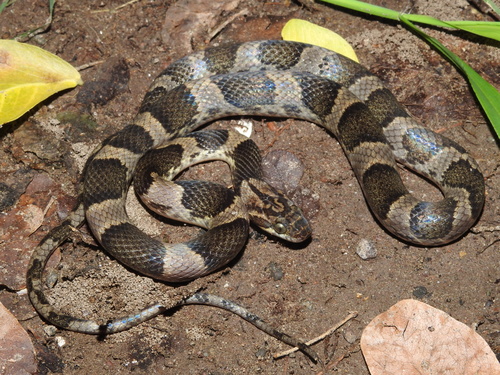
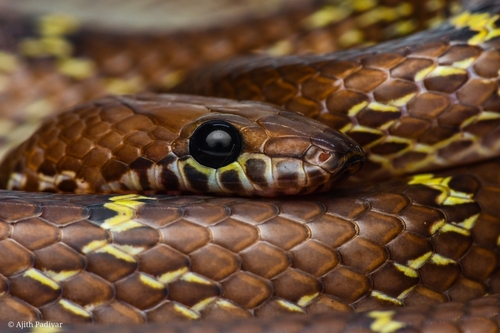
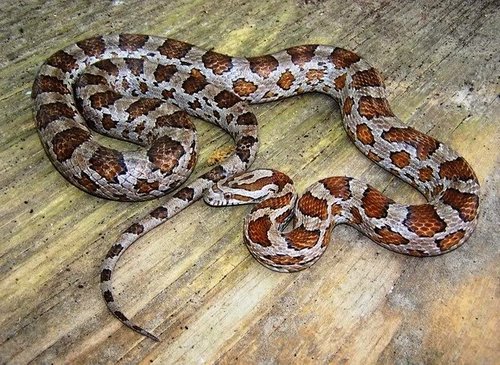
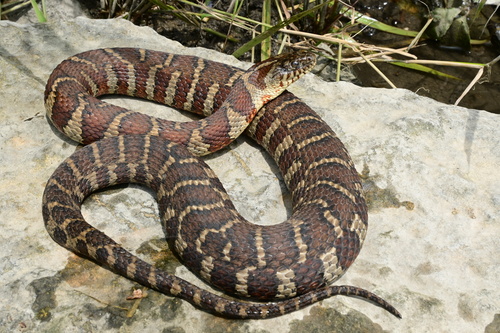
The common watersnake, Nerodia sipedon, can reach a maximum total length (including tail) of 135 cm (4 ft 5 in). One study found the average total length of adult females is 81.4 cm (2 ft 8 in), while the average for adult males is 69.6 cm (2 ft 3+1⁄2 in). Wild adult females typically weigh between 159 and 408 g (5+1⁄2 and 14+1⁄2 oz), while smaller males typically weigh 80.8 to 151 g (2+7⁄8 to 5+3⁄8 oz). The largest recorded females can weigh up to 560 g (20 oz), and the largest recorded males can weigh up to 370 g (13 oz). N. sipedon can be brown, gray, reddish, or brownish-black. It has dark crossbands across its neck and dark blotches along the rest of its body. This pattern often leads inexperienced people to misidentify it as a cottonmouth or copperhead. As N. sipedon ages, its overall color darkens, and its body pattern becomes less distinct; some older individuals become almost completely solid black. The snake's belly also varies in color, ranging from white, yellow, to gray, and usually has reddish or black crescent-shaped markings. The common watersnake is nonvenomous and harmless to humans, but it bears a superficial resemblance to the venomous cottonmouth, so it is often killed by humans out of fear. Attempting to kill a common watersnake greatly increases the chance of being bitten. The two species can be easily distinguished by physical traits: the common watersnake has a longer, more slender body, a flattened head the same width as its neck, round pupils, and no heat-sensing pits. In contrast, the cottonmouth has a thicker body, a wedge-shaped head with prominent venom glands that is wider than the neck, cat-like pupils, and heat-sensing pits located between the eyes and nostrils. The common watersnake is found throughout eastern and central North America. Its range extends from southern Ontario and southern Quebec in the north, down to Texas and Florida in the south. The subspecies northern watersnake (Nerodia s. sipedon) naturally occurs as far west as Colorado, east of the Rocky Mountains, and is commonly found in riparian ecosystems along river systems, including the South Platte River and Arkansas River. In 2007, an introduced population of common watersnake was discovered in California, where the related species Nerodia fasciata has been established as an introduced species since at least 1992. Common watersnakes mate from April through June. This species is ovoviviparous, or live-bearing, meaning it does not lay eggs like many other snake species. Instead, the female carries eggs inside her body and gives birth to free-living young. Each newborn is 19–23 cm (7+1⁄2–9 in) long. A female can produce as many as 30 young in a single birth, but the average litter size is eight. Birth occurs between August and October, and mothers provide no care for their young after birth. Females of this species are larger than males in both total length and body mass. Multiple mating by females is common, which has led to sperm competition being a key area of research on this species. Research suggests that successful males do not invest extra energy into growing larger, but instead invest more energy into producing sperm. Males typically reach sexual maturity during their second year, generally around 21 months of age. Northern water snakes undergo vitellogenesis, a process in which they produce extra yolk protein for their developing young. Because this process requires a large amount of energy, females must store significant fat reserves to support it.