About Nerodia erythrogaster (Forster, 1771)
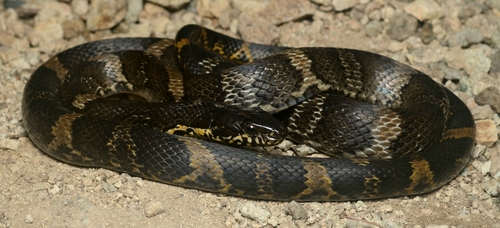
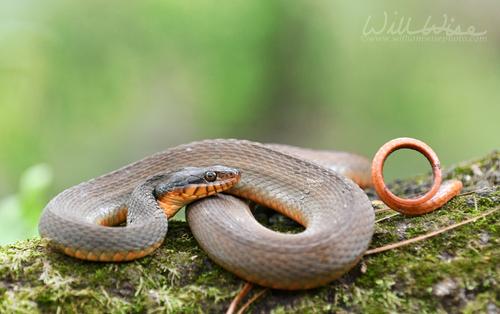
The plain-bellied water snake (Nerodia erythrogaster) is a large, thick-bodied snake that is mostly patternless, with a typically beige underside. Some individuals have a thin white line between the pale belly and their darker dorsal scales. Subspecies historically recognized for this species can have dorsal coloration ranging from dark brown, gray, and olive-green to greenish-gray or blackish. Some lighter-colored individuals have dark dorsal patterns. Plain-bellied water snakes are set apart from other water snakes by their plain, patternless undersides, which range in color from light reddish hues to beige; this unmarked belly gives the species its common name "plain-bellied". Formerly, multiple subspecies of the plain-bellied water snake were recognized, but scientists frequently struggled to distinguish between these forms, so these subspecies are no longer accepted as valid today. The scientific epithet erythrogaster comes from the Greek words erythros (meaning red) and gaster (meaning belly). This species shows geographically distinct phenotypic variation that originally led to the description of multiple unique subspecies. Adult plain-bellied water snakes have a total length between 24 and 40 inches (76–122 cm). Juvenile plain-bellied water snakes have patterns similar to banded water snakes, but can be identified by their unmarked bellies. Plain-bellied water snakes are found in every southeastern state of the United States, with the exception of higher elevations in the Appalachian Mountains, which excludes them from eastern Tennessee and western North Carolina. On the U.S. East Coast, they occur across Florida, north to southeastern Virginia, and also in western Tennessee. They are found at lower elevations from Georgia west across the Gulf States, extending as far west as Oklahoma and Texas. These snakes are almost always found near a permanent freshwater source that is usually several feet deep, and do not require water that is clear or fast-moving. They can often be seen resting on branches or foliage directly over water, which provides them with an easy escape route. Within their native range, they are adapted to a wetland lifestyle, and are most often found at or near creeks, rivers, swamps, floodplains, lakes, and ponds, as well as human-made features including reservoirs, dams, and canals. Like other North American water snakes and garter snakes, the plain-bellied water snake is ovoviviparous, meaning it bears live young. In the southeastern U.S., this species breeds from April through mid-June. Females give birth between August and September. A typical litter has around 18 young, but litters can be larger; a female in North Carolina was recorded with a litter of 55 hatchlings. In 2014, a captive female plain-bellied water snake produced two healthy offspring through parthenogenesis.