About Nerodia cyclopion (Duméril, Bibron & Duméril, 1854)
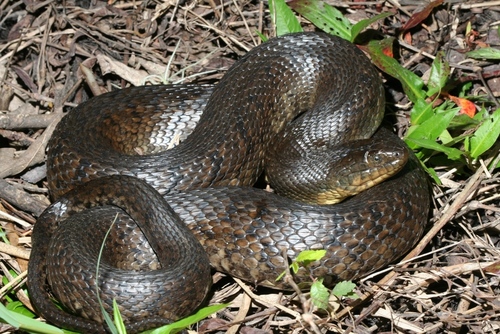
This species, scientifically named Nerodia cyclopion (Duméril, Bibron & Duméril, 1854), can be distinguished from most other North American water snake species by the presence of one or more small scales under its eye. This trait creates the appearance of a ring of small plates around the eye, a feature it shares only with the species Nerodia floridana. N. cyclopion is a heavy-bodied snake. Its dorsal side is dark green, olive, or brown, while its ventral side is yellowish across the anterior third. The remaining ventral area is dark brown with yellow or white semicircular markings. On average, N. cyclopion reaches a total length (including the tail) of 76–140 cm (30–55 inches). Geographically, N. cyclopion ranges from the Florida panhandle westward to Louisiana, and extends northward through the Mississippi Valley into southern Illinois. More specifically, it occurs in southwestern Alabama, southeastern Arkansas, northwestern Florida, southern Illinois, southwestern Indiana, western Kentucky, Louisiana, southern Mississippi, southeastern Missouri, western Tennessee, and southeastern Texas. The species' type locality is New Orleans, Louisiana. For habitat, N. cyclopion prefers still water environments including bayous, lakes, marshes, ponds, sluggish streams, and swamps. It can occasionally be found in brackish water. Commonly called the green water snake, N. cyclopion is ovoviviparous. Mating occurs on land in April. Young snakes are born in July or August, and measure approximately 25 cm (10 inches) long at birth. Brood size ranges from 7 to 101 young, and this variation depends on the size of the female. Females are larger than males, have two more dorsal scale rows than males, and may weigh over 4.1 kg (9 lb).