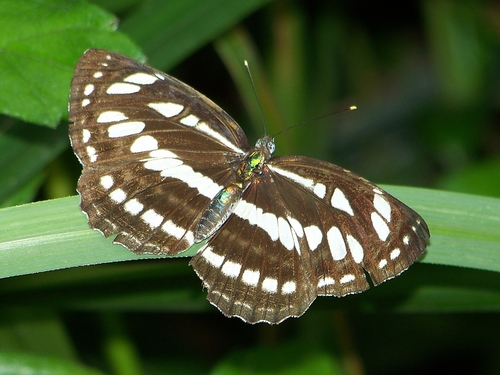
About Neptis hylas Linnaeus, 1758
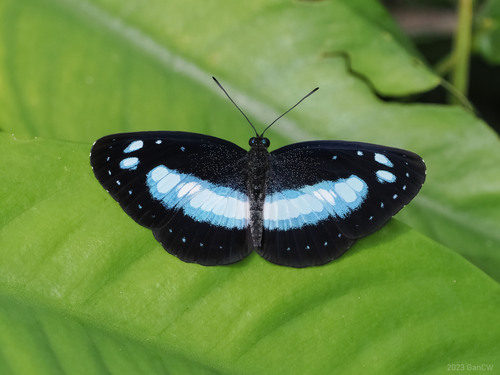
This species is Neptis hylas Linnaeus, 1758, with a described dry-season form and wet-season form. For the dry-season form: The upperside is black, with pure white markings. On the forewing, the discoidal streak is clavate (club-shaped), apically truncate, and either notched or sometimes indistinctly divided subapically. The triangular spot beyond this streak is broad, well defined, and acute at the apex, but not elongate. The discal series of spots are separate, not connate (united), and each is about twice as long as broad. The postdiscal transverse series of small spots is incomplete, but some spots are always present. On the hindwing of the dry-season form, the subbasal band has an even or nearly even width; the discal and subterminal pale lines are obscure; the postdiscal series of spots are well separated, quadrate or subquadrate, and very seldom narrow. The underside of the dry-season form ranges from pale golden ochraceous to dark ochraceous, almost chocolate; the white markings match those on the upperside, but are broader and outlined in black. On the forewing, interspaces 1a and 1 are shaded black from the base to near the apex, and there are some narrow transverse white markings on either side of the transverse postdiscal series of small spots. On the hindwing, there is a white streak on the costal margin at the base, with a more slender white streak below it; the discal and subterminal pale lines present on the upperside are replaced by narrow white lines, which are bordered by even narrower black margins. Antennae, head, thorax, and abdomen are black; the underside of the palpi, thorax, and abdomen is dusky white. The wet-season form differs only in that its white markings are narrower, its ground color is slightly darker, and the black margins to the spots and bands on the underside are broader. More than 20 subspecies have been described. This species has been observed to produce sounds, whose function has not been established. Its distribution covers continental India, Sri Lanka, Assam, Nepal, Myanmar (Tenasserim), and extends to China and Indomalaya.