About Nepita conferta (Walker, 1854)
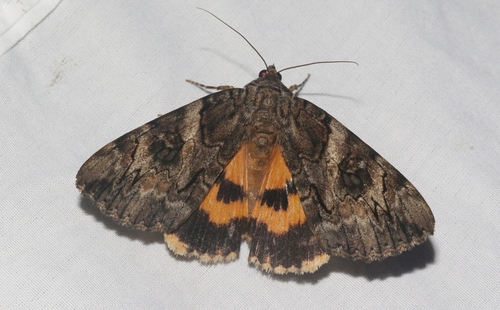
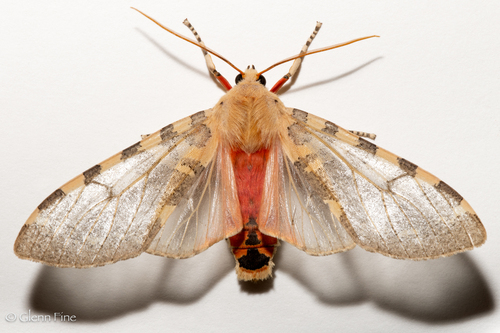
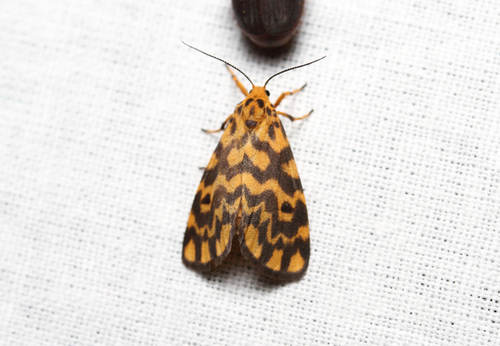
This species is the moth Nepita conferta, first described by Walker in 1854. Its palpi are porrect, meaning they extend forward past the frons, and are fringed with hair on the lower side. Antennae are covered in rough scaling; male antennae are bipectinate with short branches. The tibia bears long spurs. Forewings are broad and short. Veins 3 to 5 arise close to the angle of the cell, vein 6 arises from below the upper angle, veins 7 to 9 are stalked, and vein 11 anastomoses with vein 12. On hindwings, veins 4 and 5 are stalked, veins 6 and 7 are stalked, and vein 8 arises from beyond the middle of the cell. The head and thorax are orange, and the thorax has black spots. The abdomen is black, and is orange on the underside and at its extremity. Forewings are orange with a number of black marks at the base. The antemedial and medial bands are curved and waved, and they coalesce at the median vein. There is a black spot on the discocellulars. The postmedial band is waved and curves outward around the end of the cell. A series of submarginal spots and streaks is present, and these are often conjoined into a single band. The margin and cilia are black. Hindwings have an orange base and a broad marginal black band. The pattern of spots and streaks varies between the regions this moth inhabits. The limbata and ochracea forms have narrow bands on the forewings, while the forms conferta, aegrota, and anila have broad bands on the forewings. The fusca form from Sri Lanka is suffused with brown. These consistent regional variations led to the species being incorrectly split into many separate binomial species in earlier taxonomic work. The larva is purplish black, short, and swollen in shape. Each body segment is thickly covered with long black hair tufts. Dorsal orange marks are present on the first, seventh, and anal body segments, with a slender line running from the seventh to the anal segment. This moth is most often found in wet, moist habitats. Larvae feed mainly on mosses and lichens, and have been recorded as a minor pest of brinjal. Caterpillars are highly adaptable to domestic conditions; they are frequently found on moist walls during the rainy season, sometimes in large numbers. This species is known to be a host for parasitoid wasps of the genus Glyptapanteles.