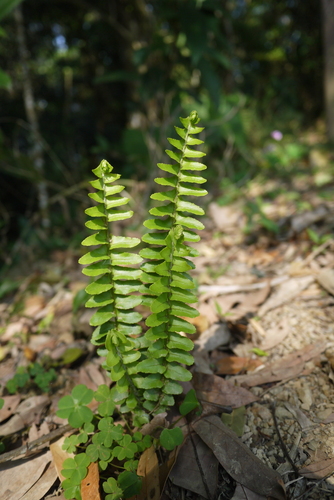
About Nephrolepis cordifolia (L.) C.Presl
Species Identity and Growth Height
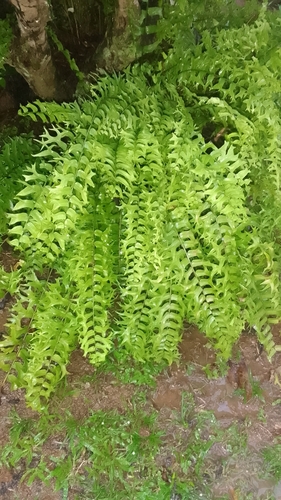
Nephrolepis cordifolia (L.) C.Presl is an evergreen fern that typically grows 40 to 80 centimeters tall, and can reach up to 1 meter in extreme cases.
Underground Rhizome Structure
It produces an underground rhizome made up of several small tubers.
Frond Morphology
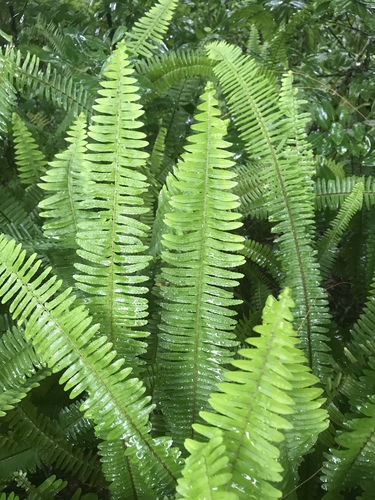
Its fronds are pinnate, simple, glandular, and shaped like erect pinnate linear to lanceolate structures.
Rachis and Petiole Scales
The rachis carries bicolored chaff scales, while the petiole is covered with bicolored scales that range from pale to dark brown.
Leaflet Characteristics
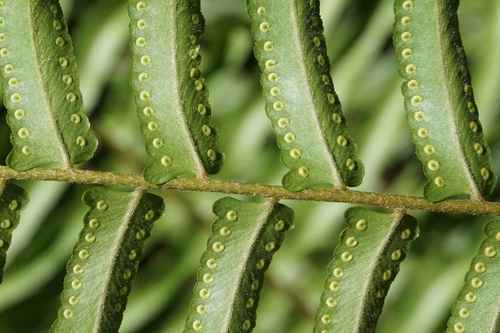
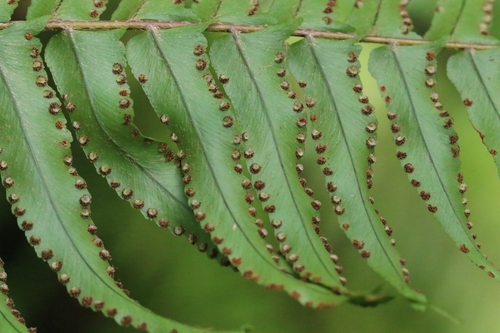
The leaflets are entire, sessile, and elongate-lanceolate; they can grow up to 4.8 centimeters long and 0.9 centimeters wide, and are spaced less than 1 centimeter apart.
Sori and Spore Traits
The species has rounded sori, and its spores are warty and wrinkled.
Native and Naturalised Range
This species is originally native to northeastern Australia and the foothills of the Himalayas, and is considered naturalised on the central east coast of New South Wales.
Growth Substrate Types
Plants can establish themselves as terrestrials, epiphytes, or lithophytes, as long as the location has suitable moisture and light levels.
Epiphytic Growth Habit
In good conditions, these ferns grow easily as epiphytes, most often attaching to the bark of tree branches above a water source where they can get constant humidity and airflow.
Habitat Types
They can grow in many different environments, including deep swamps, riverbanks, rugged outcrops, rock faces, roadsides, ditches, creeks, fallen trees, and even abandoned buildings and ruins.
Preferred Habitat Conditions
They prefer moist, shady locations; within their native range, they usually grow as epiphytes in swamps, or grow terrestrially along brooks and ditches in coniferous forest floodplains.
Introduced Range
It has been introduced to Bermuda, French Polynesia, New Zealand, and the United States.
Human-cultivated and Global Distribution
It is also widely cultivated and distributed by humans, and is currently found in tropical regions of North, Central, and South America (primarily in Mexico, the Caribbean, and parts of California and Florida), as well as in Africa, Southeast Asia, various South Pacific islands, and the Azores.
Hawaiian Common Names
In the Hawaiian Islands, it is known as kupukupu, okupukupu or ni'ani'au.