About Nephila pilipes (Fabricius, 1793)
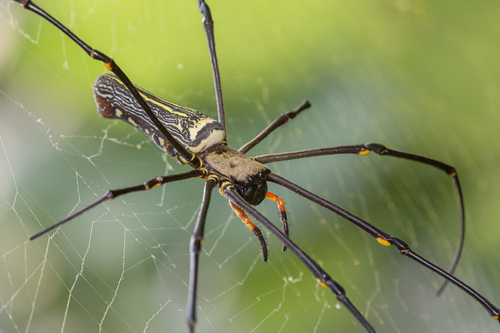
Nephila pilipes exhibits female gigantism and male dwarfism, a form of sexual size dimorphism. Among terrestrial animals, this species has the largest size difference between males and females. This pattern is thought to result from evolutionary selection favoring females with higher fecundity, as females make large parental investments in their offspring, including egg production and web construction. N. pilipes prefers moist, shaded habitats that receive no direct sunlight. It has been recorded in Japan, China, Vietnam, Cambodia, Taiwan, Malaysia, Singapore, Myanmar, Indonesia, Thailand, Laos, the Philippines, Sri Lanka, India, Pakistan, Nepal, Papua New Guinea, and Australia. In Australia, most N. pilipes populations are found in rainforest habitats of northern and eastern Australia, where the climate is humid and vegetation provides shade from direct sunlight. Overall, the species is generally distributed along coastal areas with ample precipitation, but there are confirmed reports of N. pilipes occurring in dry sclerophyll and low shrubland habitats hundreds of miles inland from the coast. It can survive in a wide range of climate types, including temperate coastal, Mediterranean, subtropical, and tropical savannah climates. N. pilipes constructs its webs on bushes and trees, near surface water, and against buildings and other terrain structures. Like other species in the Nephila genus, N. pilipes displays specialized thermoregulatory behavior to avoid excess solar heat. Experimental observations show that when temperatures reach 32 °C, Nephila individuals adjust the angle of their body relative to incoming sunlight: they orient their abdomen toward the sun while keeping the cephalothorax parallel to the web. As temperatures rise further, they align their entire body along the direction of sunlight to further reduce the body area exposed to solar heat. At temperatures above 40 °C, Nephila individuals will abandon their webs. Unlike many of its related species, the distribution and activity of N. pilipes do not vary with seasons. Adult females are active year-round and lay eggs continuously, and adult males remain present in populations for longer periods than adult females.