About Neottia ovata (L.) Bluff & Fingerh.
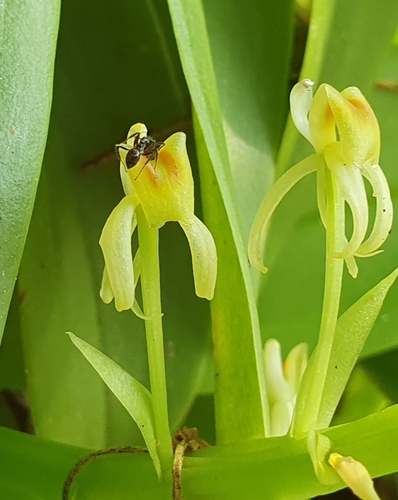
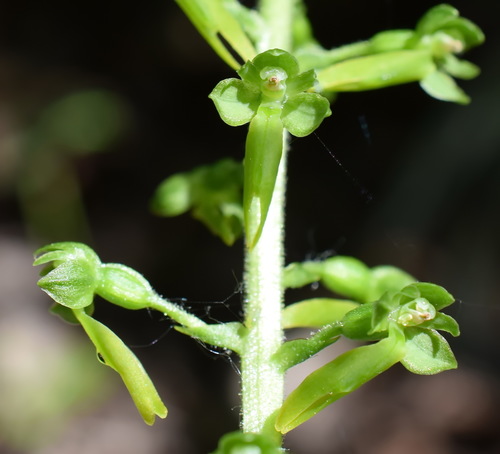
The flowering stems of Neottia ovata are typically 20–60 cm (7.9–23.6 in) tall, and occasionally reach up to 75 cm (30 in). It produces two large opposite basal leaves, each 5–20 cm (2.0–7.9 in) long. A variable number of flowers grow on its stems, usually between 15 and 100. The flowers are small and yellowish-green. The sepals and two side petals form a fairly open hood that measures 5–6 mm (0.2 in) long. The labellum, or central lip petal, is 7–15 mm (0.3–0.6 in) long and split into two lobes at its tip. Due to its slender shape, small flowers, and green colouring, this species can be difficult to spot.
This orchid is found across much of Europe including the British Isles, as well as Siberia, Central Asia, Southwest Asia, and the Himalayas. It has been introduced to Ontario, Canada, where it is commonly called the eggleaf twayblade. Neottia ovata grows in a diverse range of habitats, including woods, meadows, dune-slacks, and moorland.
The flowers of Neottia ovata are easily accessible to a wide variety of insects. It is primarily pollinated by parasitic wasps, sawflies, and beetles. Its pollinia lie free on top of a gutter-shaped rostellum, an organ filled with viscid fluid. When an insect touches the sensitive tip of the rostellum, the viscid fluid is ejected and glues the pollinia to the insect's body. Fruit set in this species is quite high. Over 60 species of mycorrhizal fungi have been recorded forming associations with N. ovata. Neottia ovata is one of the most common orchid species in Europe, a status partially explained by its low species selectivity for both pollinators and mycorrhizal partners. It is also an inconspicuous species that blends into surrounding vegetation, which prevents it from being picked by humans; this picking is a threat that endangers many showier orchid species. Despite this relative success, evidence shows that Neottia ovata populations are currently declining.