About Neottia cordata (L.) Rich.
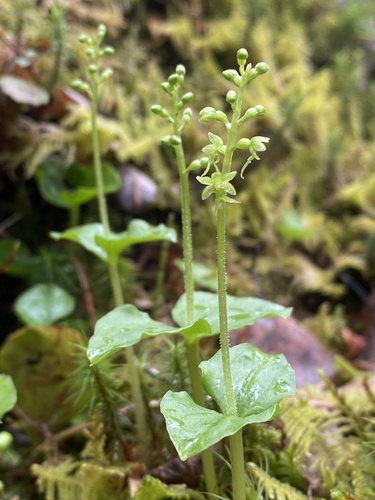
Neottia cordata, commonly called heartleaf twayblade, is a herbaceous orchid. Its flowering stems grow between 3 and 33 centimeters (1.2 to 13.0 inches) tall, most often between 5 and 10 cm (2.0 to 3.9 in). Most plants produce just one flowering stem, though rarely up to three stems may grow on a single plant. The stem is hairless, succulent, and ranges in color from green to purple-red. Leaves clasp the stem between one-third and halfway up a flowering stem, or at the top of a non-flowering stem. The glossy leaves have a shiny dark green upper surface, and are shaped ovate (egg-like) to cordate (heart-shaped). They measure 0.9 to 4 cm long by 0.7 to 3.8 cm wide, though most are less than 2 cm in both length and width. Most stems hold two nearly paired leaves, and very rarely a single stem may have up to four leaves. The inflorescence most often holds 3 to 15 blooms along the upper 1.5 to 4 cm of the stem, and sometimes may hold as many as 25 flowers. The flowers are quite small, only 2 to 3 millimeters across. Their petals range in color from yellow-green to green to reddish purple, and they produce a quite strong scent that botanists have described as "truly repulsive" and similar to the smell of rotting molluscs. This species has a circumpolar distribution, found across Europe, Asia, and large portions of North America. In the United Kingdom, it is distributed mostly in the west and north, where it is most common in the western Highlands of Scotland, Snowdonia in Wales, and the Lake District and Pennines in England. A small population also exists as far south as Exmoor. The flowers of Neottia cordata produce nectar, and are principally pollinated by fungus gnats in the families Mycetophilidae and Sciaridae. Its mycorrhizal partners are almost exclusively fungi from the Sebacinales clade Serendipitaceae, and it may also have some association with fungi from Ceratobasidiaceae and/or Tulasnellaceae.